Public Opinion on Prescription Drugs and Their Prices
Editorial Note: This data note was updated on March 31, 2026, to reflect updated poll findings.
Key Takeaways
This data note summarizes KFF polling on the U.S. public’s experiences with prescription drug costs, use of GLP-1 medications, and support for policy solutions. Key takeaways include:
- Most U.S. adults take at least one prescription drug, and many struggle or worry about affording their prescription medications. Six in ten adults say they are worried about being able to afford their prescription drug costs, a new high since KFF began asking in 2018. Four in ten say they have had to take cost-saving measures, such as skipping doses, not filling prescriptions, or taking other measures due to costs.
- Increasing use of GLP-1 medications raises particular cost concerns. About one in five adults have ever taken a GLP-1 medication, and most users – including those with health insurance – say these drugs are difficult to afford. KFF will continue to monitor the public’s experiences with GLP-1 medications as use, regulation, and new formulations – including oral versions – continue to evolve.
- Large majorities across party lines want the government to do more to regulate drug prices, and many support a range of policies. At least two-thirds of Democrats, independents, and Republicans say there is not enough regulation of prescription drug prices. Most support a range of policies to address costs, such as two provisions of the 2022 Inflation Reduction Act (IRA): allowing Medicare to negotiate prices and limiting how much drug companies can increase the price of drugs based on annual inflation rates.
- The Trump administration has taken several steps to try to lower prescription drug costs in its second term, but these initiatives have limited public visibility so far. Few adults have heard much about the administration’s drug pricing deals with manufacturers or TrumpRx, the federal website that provides discount coupons for certain drugs, launched in early 2026. KFF polling from 2019 found broad support for a related approach – lowering what Medicare pays for some drugs based on amounts in other countries – suggesting the idea has public appeal even if awareness of the current initiatives and the debates around them remain low.
The Public’s Experiences with and Views of Prescription Drugs
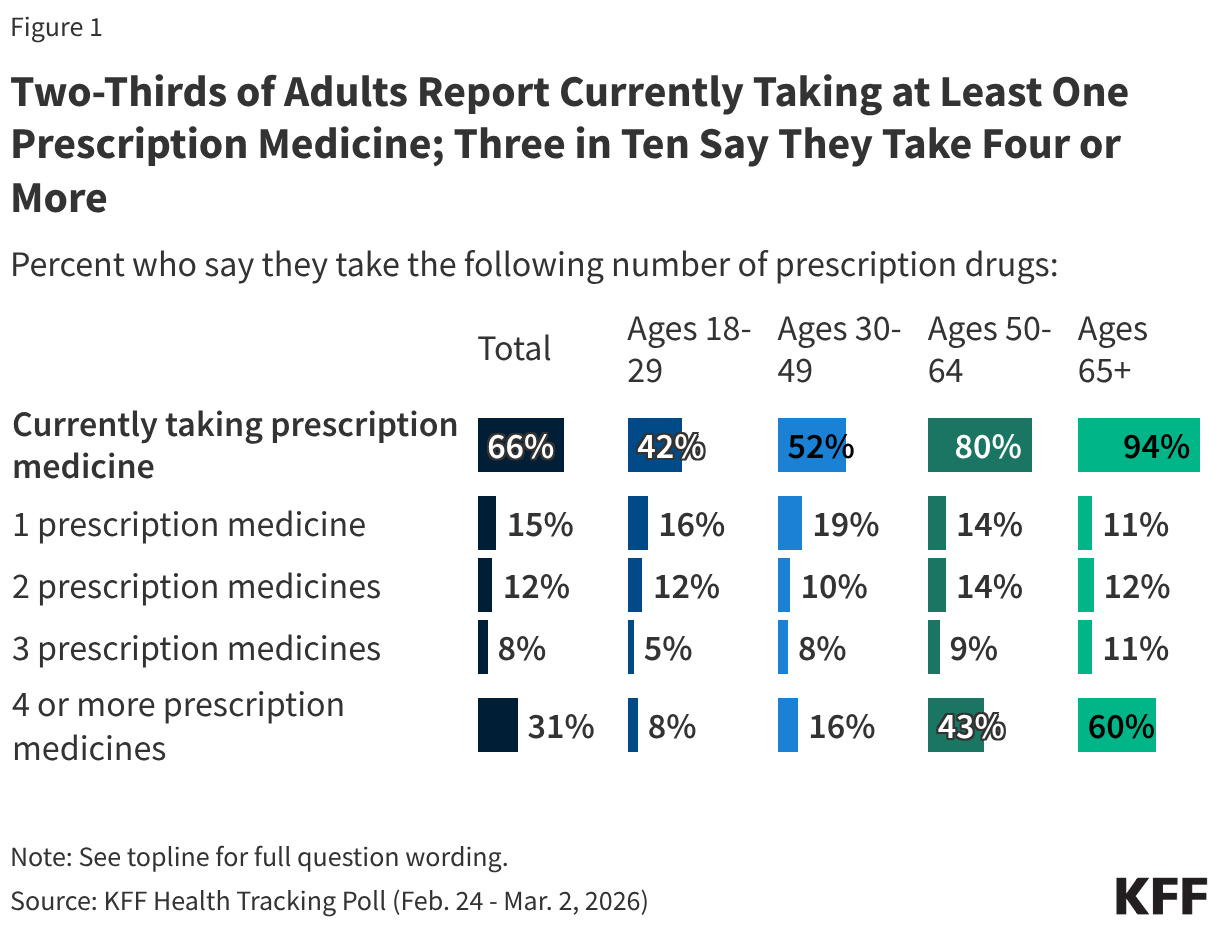
Prescription drugs touch the lives of most people in the U.S. in some way, and the public broadly recognizes their benefits. About two-thirds (66%) of adults say they are currently taking at least one prescription drug, and three in ten (31%) say they currently take four or more prescription medications. While many adults across age groups take prescription medications, older adults are much more likely to report taking 4 or more medications.
Six in ten adults ages 65 and older report taking four or more prescription medications, compared to fewer than half of younger adults.
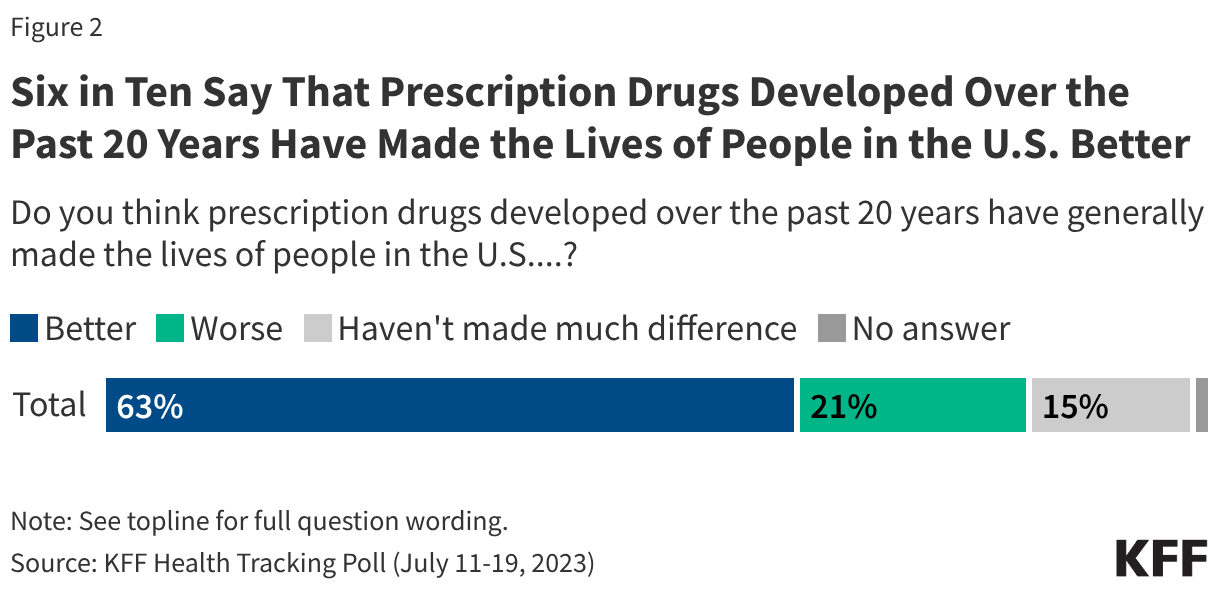
The public generally sees the benefits of these medicines. About six in ten (63%) adults believe prescription drugs developed over the past 20 years have generally made the lives of people in the U.S. better, while much smaller shares (21%) say they’ve made them worse or have not made a difference (15%).
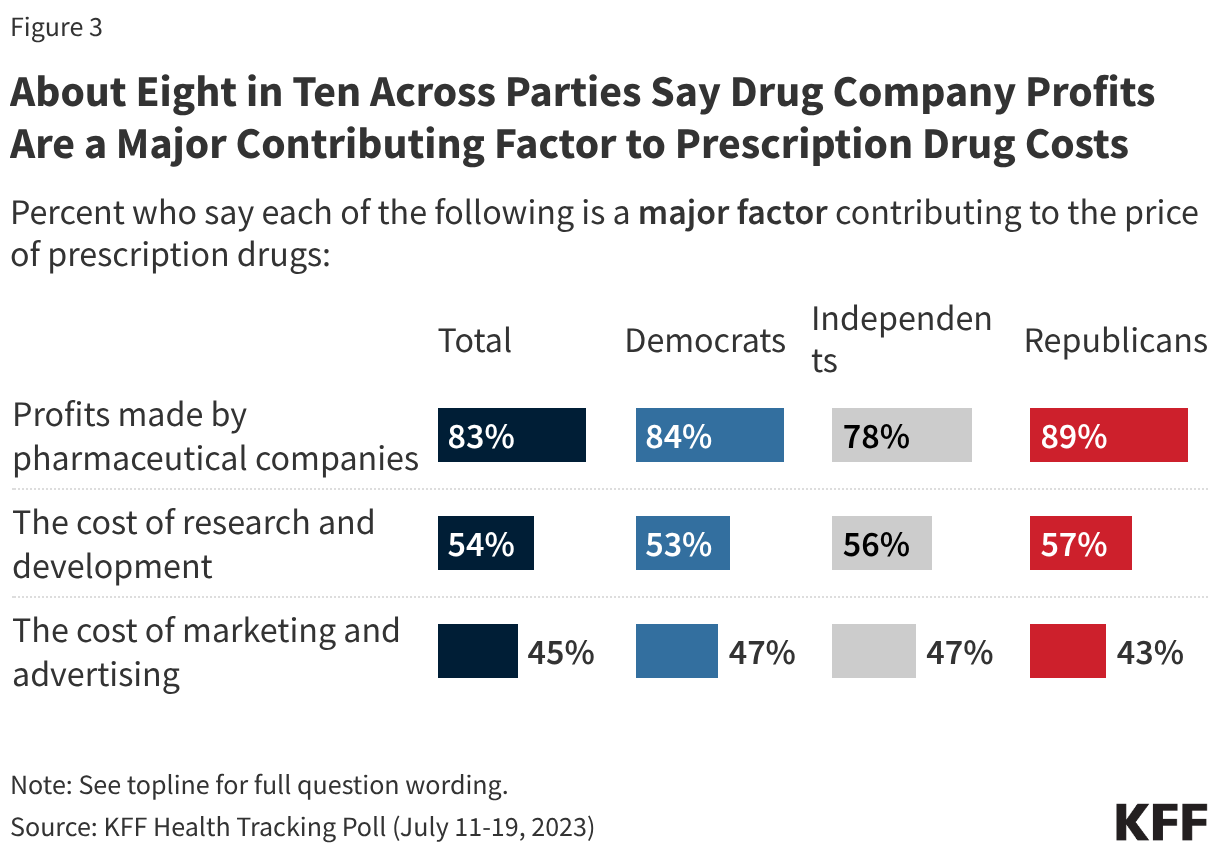
Despite seeing their general benefits to society, about eight in ten adults (82%) say the cost of prescription drugs is unreasonable, and the public sees profits made by pharmaceutical companies as the largest factor contributing to these prices. More than three-quarters of adults across partisanship say profits made by pharmaceutical companies are a “major factor” in the price of prescription drugs. This is followed by more than half who say the cost of research and development is a “major factor” contributing to the price, and 45% saying the same about the cost of marketing and advertising.
Struggles Affording Prescription Drugs
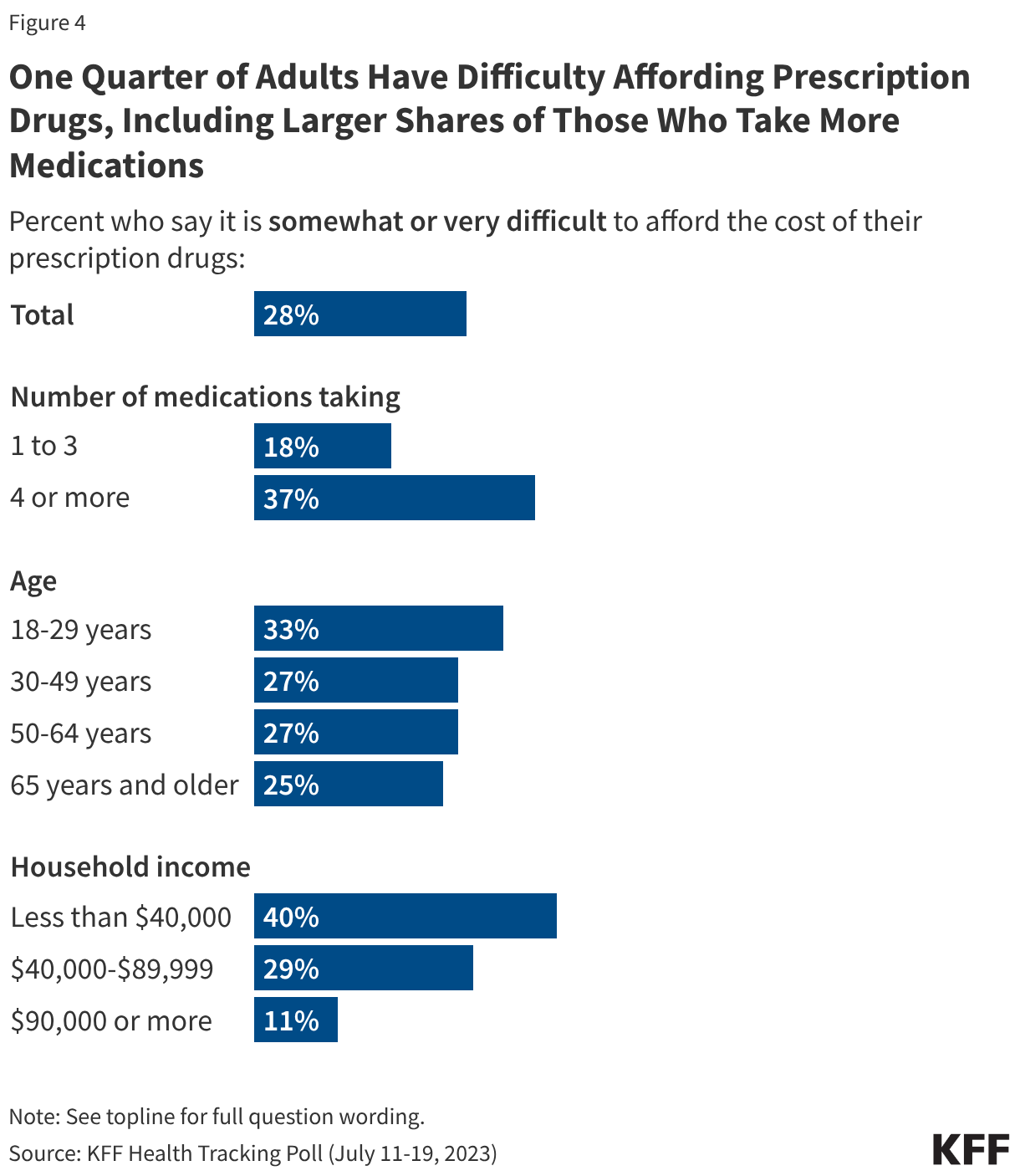
Many Americans face significant challenges affording their medications, including adults who take more medications or have lower incomes. KFF polling shows these challenges have grown more acute over the years. While about two-thirds (65%) of adults overall say it is “very” or “somewhat” easy to afford their prescription drug costs, affordability is a bigger issue for those who are currently taking four or more prescription medicines. Nearly four in ten (37%) of those taking four or more prescription drugs say they have difficulty affording their prescriptions, compared with one in five (18%) adults who currently take three or fewer prescription medications. Adults with an annual household income of less than $40,000 are also more likely than adults with higher incomes to report difficulty affording their prescription medications.
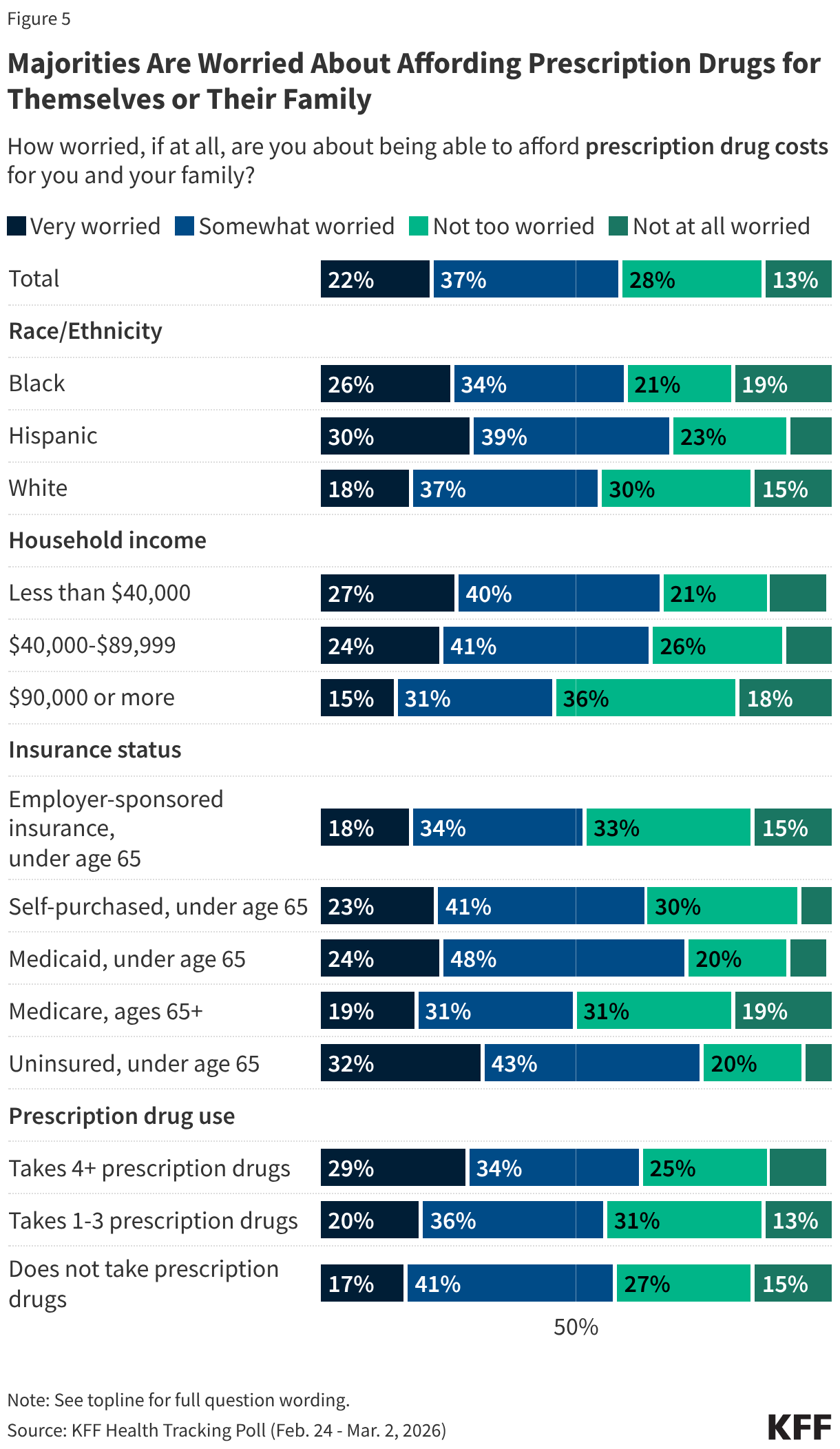
Overall, about six in ten adults say they are worried about being able to afford prescription drug costs for themselves or their families (59%), including about one in five (22%) who are “very worried.” Worry varies by insurance status, household income, race, and ethnicity. Substantial shares of uninsured adults under age 65 (32%), Hispanic adults (30%), Black adults (26%), and adults in households with annual incomes less than $40,000 (27%) say they are “very worried” about affording their prescription drug costs.
Among adults who take four or more prescription medications, about two-thirds (64%) report worrying about affording their medications, including about three in ten (29%) who are “very worried.” However, worry is not limited to those who take at least four medications. Most adults who take fewer prescriptions (1 to 3) worry about being able to afford their medications (56%). Even among adults who do not currently take any prescriptions themselves, a majority (57%) are “very” or “somewhat worried” about affording prescription medications, perhaps reflecting concerns about future needs or the prescription drug costs of family members.
Notably, about one in five (19%) Medicare enrollees say they are “very worried” about affording their prescription drug costs. Although older adults are more likely to take more prescription medications than younger adults, the vast majority of Medicare beneficiaries are enrolled in Medicare Part D plans, giving them prescription drug coverage that has improved with recent policies in the Inflation Reduction Act of 2022.
About one in four (24%) Medicaid enrollees under age 65 say they are “very worried” about affording their prescription drug costs. Medicaid provides comprehensive access to prescription drugs for eligible adults, with out-of-pocket costs limited to nominal amounts, which helps adults avoid cost-related prescription medication rationing or delays. However, while prescription out-of-pocket costs in Medicaid are limited, even low amounts may still be prohibitive for low-income families with Medicaid.
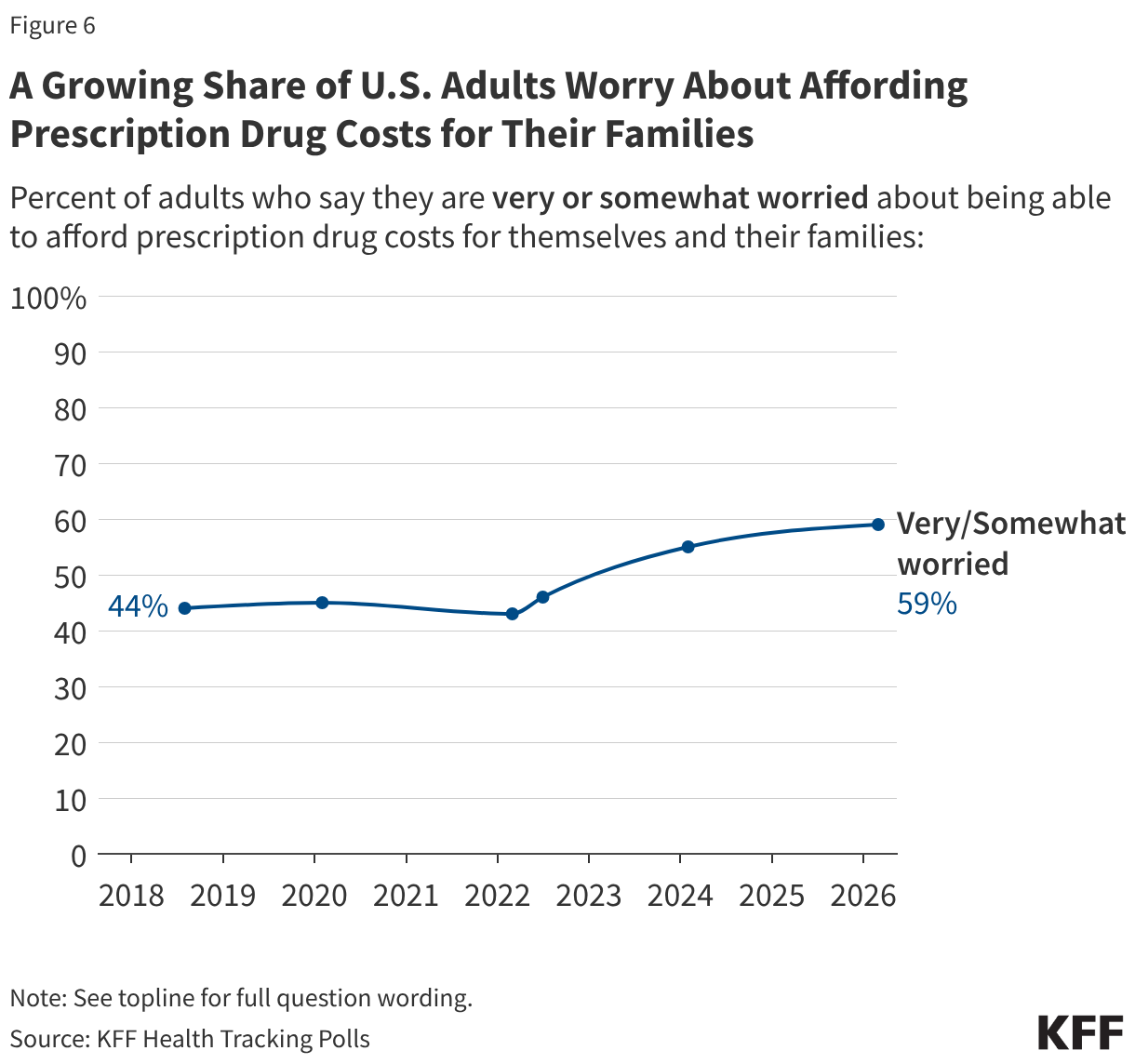
Since KFF first asked about worries affording prescription drug costs in 2018, the share of adults reporting worries has increased steadily, to a new high of six in ten (59%) in 2026.
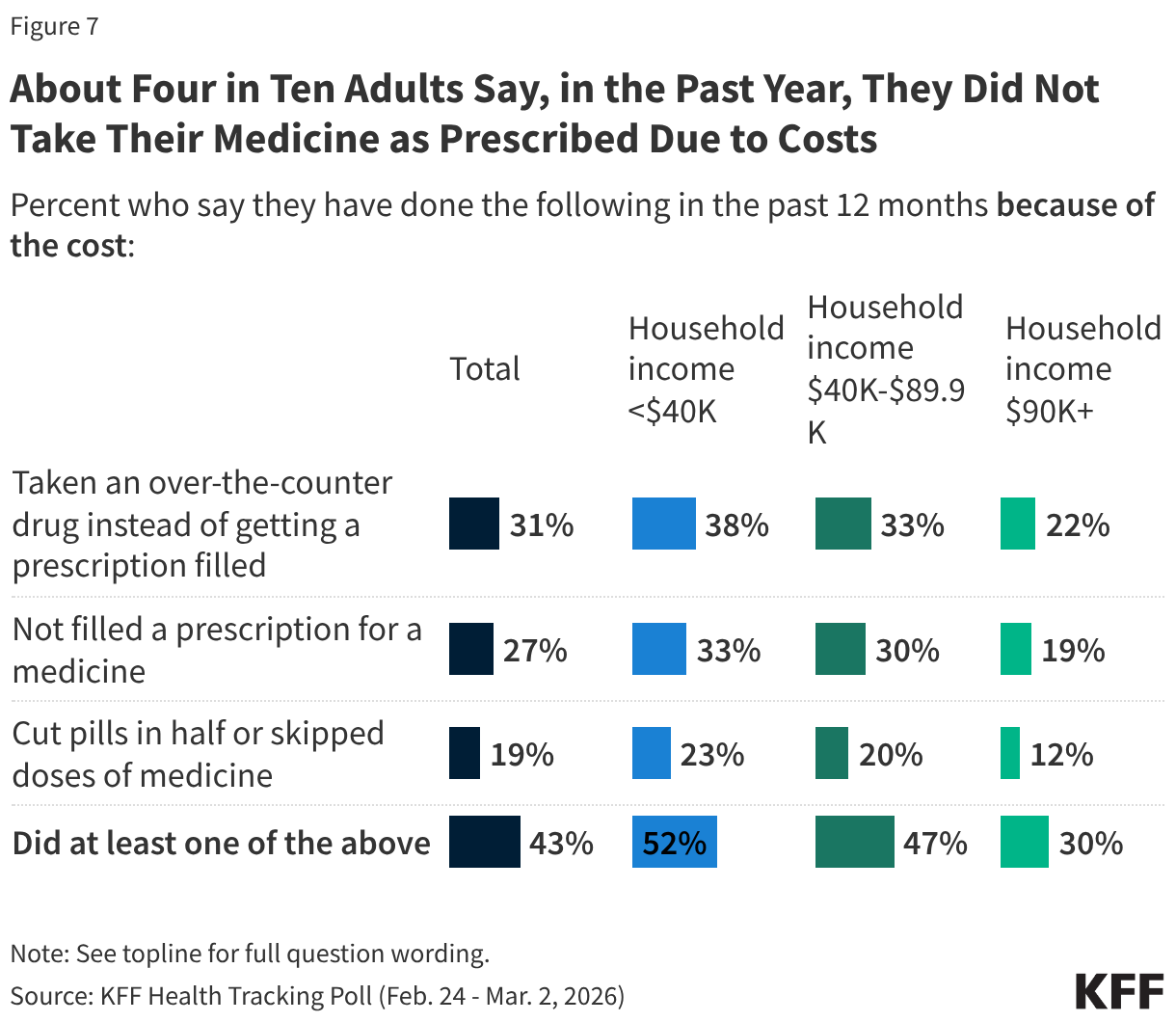
About four in ten (43%) adults report that they have not taken their medication as prescribed at some point in the past year because of the cost. This includes three in ten who have taken an over-the-counter drug instead (31%), a quarter who have not filled a prescription (27%), and about one in five (19%) who have cut pills in half or skipped doses of medicine because of the cost.
The share who reports not filling a prescription, taking an over-the-counter drug instead, or cutting pills in half or skipping doses increases to about half among adults with annual household incomes less than $40,000 (52%).
GLP-1 Use and Affordability
In recent years, KFF has been tracking the public’s use and experiences with GLP-1 medications. These medications, such as semaglutide or tirzepatide, are used for weight loss or managing chronic health conditions. As GLP-1 medications have expanded beyond their original use for treating Type 2 diabetes, their popularity, combined with their high cost and need for long-term use, poses a potential cost burden on consumers, employers, and insurers. In response, some employers have restricted or dropped coverage for weight loss in 2026. Medicare Part D currently covers GLP-1 drugs only when prescribed to treat chronic illnesses such as diabetes and sleep apnea but prohibits the coverage for weight loss alone under federal law. Under the Medicaid Drug Rebate Program (MDRP), state Medicaid programs must cover GLP-1s for conditions like diabetes, but coverage for obesity is optional under federal law.
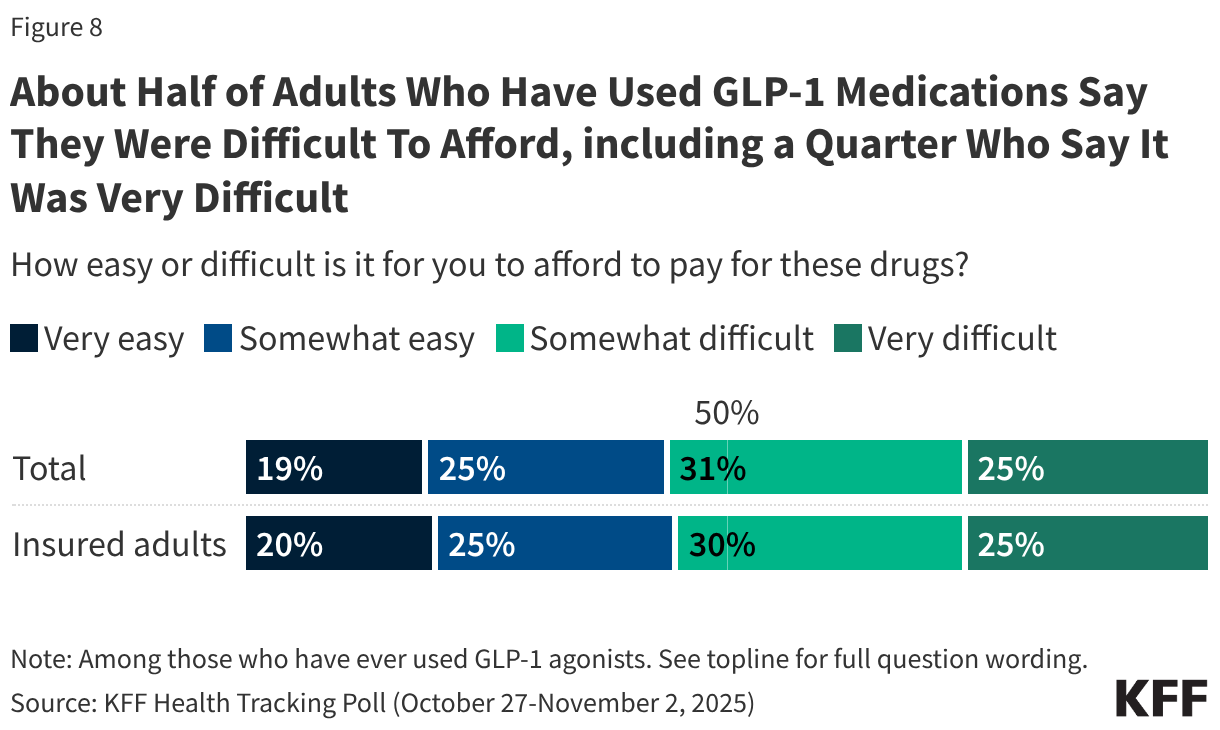
As of March 2026, KFF Health Tracking Polls show about one in five adults have ever taken a GLP-1 medication (18%), including 12% who currently take this class of medication (an increase of 6 percentage points from May 2024).
While most GLP-1 users get their medications from a primary care doctor and have them at least partially covered by insurance, a majority, including 55% of those who have health insurance, say it is difficult to afford these drugs. KFF will continue to monitor the public’s experiences with GLP-1 medications as use, regulation, and new formulations – including oral versions – continue to evolve.
Public Support for Drug Pricing Policies
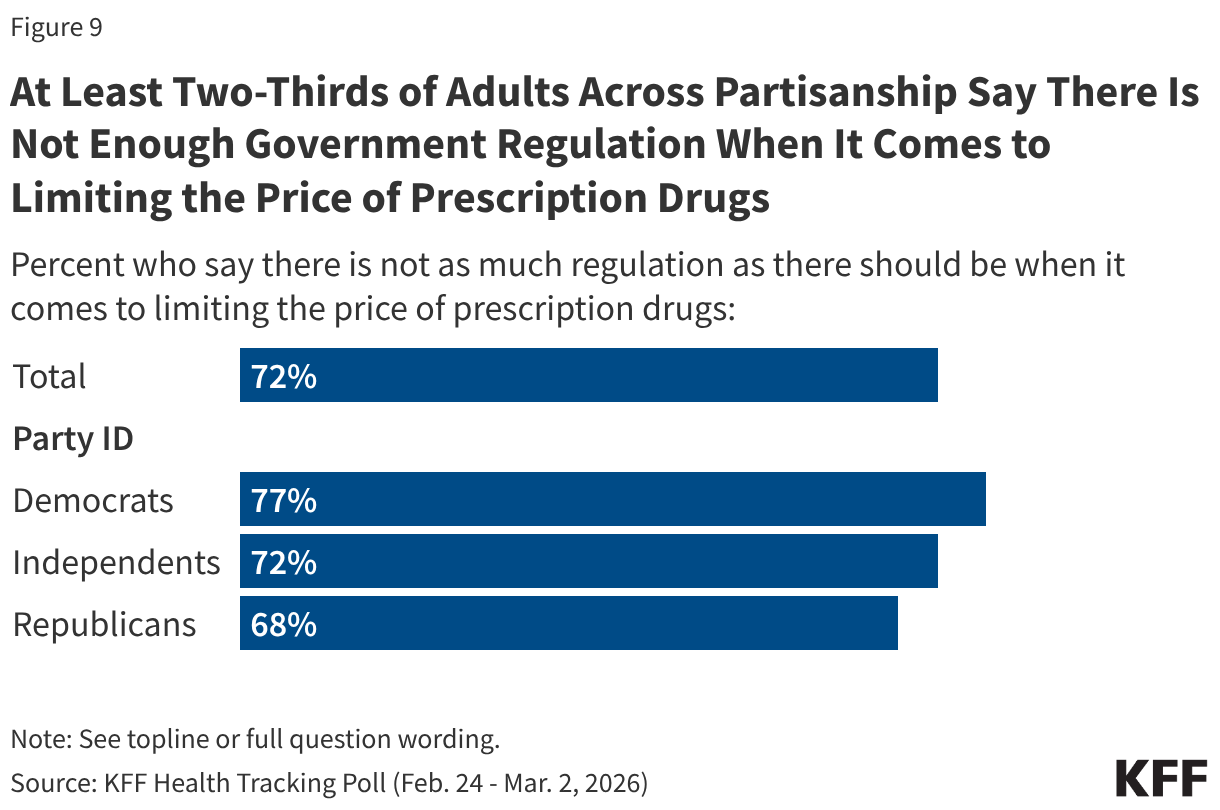
There is broad, bipartisan agreement that there should be more government regulation when it comes to prescription drug costs. The March 2026 KFF Health Tracking Poll finds about seven in ten adults (72%) say there is “not as much regulation as there should be” when it comes to limiting the price of prescription drugs, including at least two-thirds of Democrats (77%), Republicans (68%), and independents (72%).
Notably, larger shares of adults now say there is not enough regulation than five years ago, though KFF has found bipartisan agreement on this attitude since 2015.
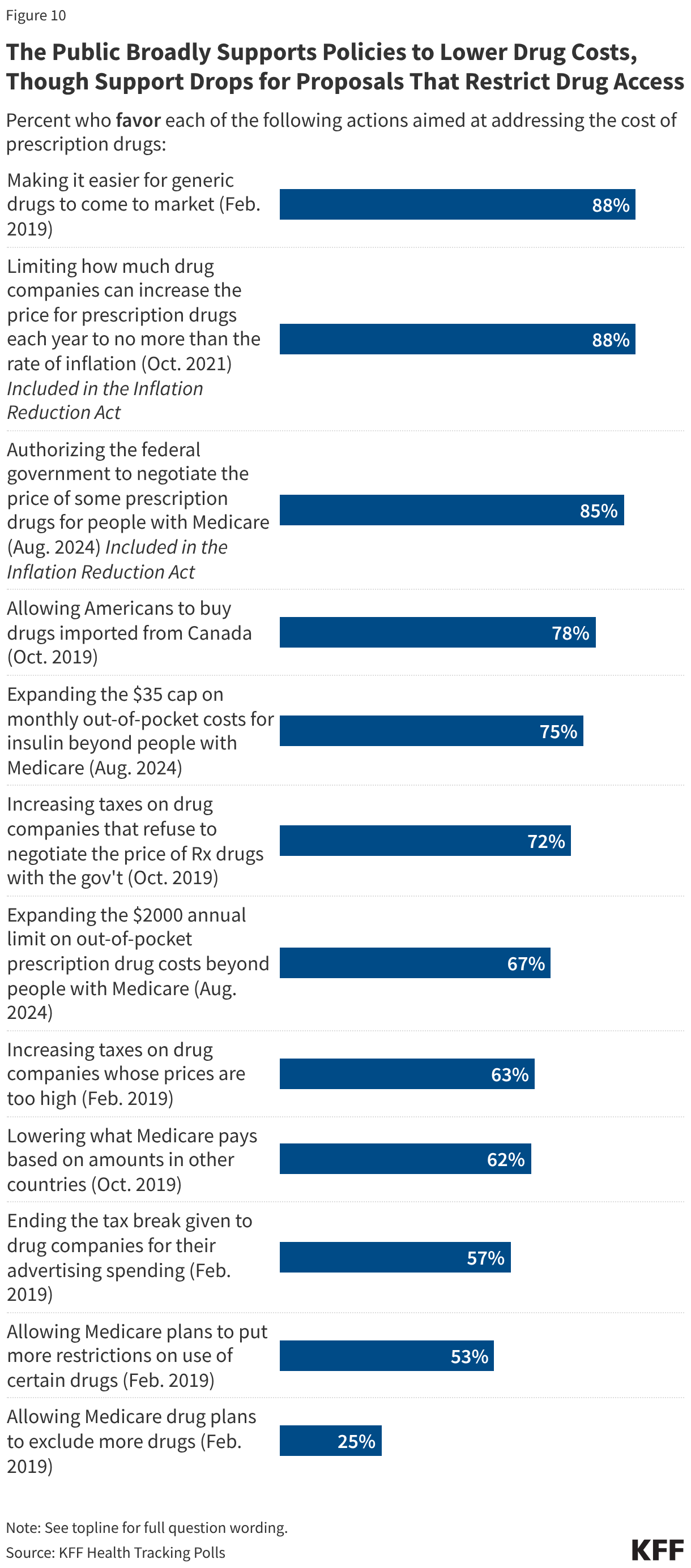
For decades, lawmakers have debated and passed drug pricing legislation. For example, in 2022 the Inflation Reduction Act, or IRA, included several provisions aimed at lowering prescription drug costs. The public largely supports many of these provisions, including limiting how much drug companies can increase the price of drugs based on annual inflation rates (88%) and allowing the federal government to negotiate with drug companies to get a lower price on medications for people with Medicare (85%).
KFF polling shows the public – across partisans – is also supportive of other policy proposals that have been debated but not been put into law, such as increasing taxes on drug companies that refuse to negotiate the price of their drugs with the government, allowing Americans to buy drugs imported from Canada, making it easier for generic drugs to come to market, and expanding the IRA’s annual out-of-pocket maximum and monthly cap on insulin prices beyond people with Medicare.
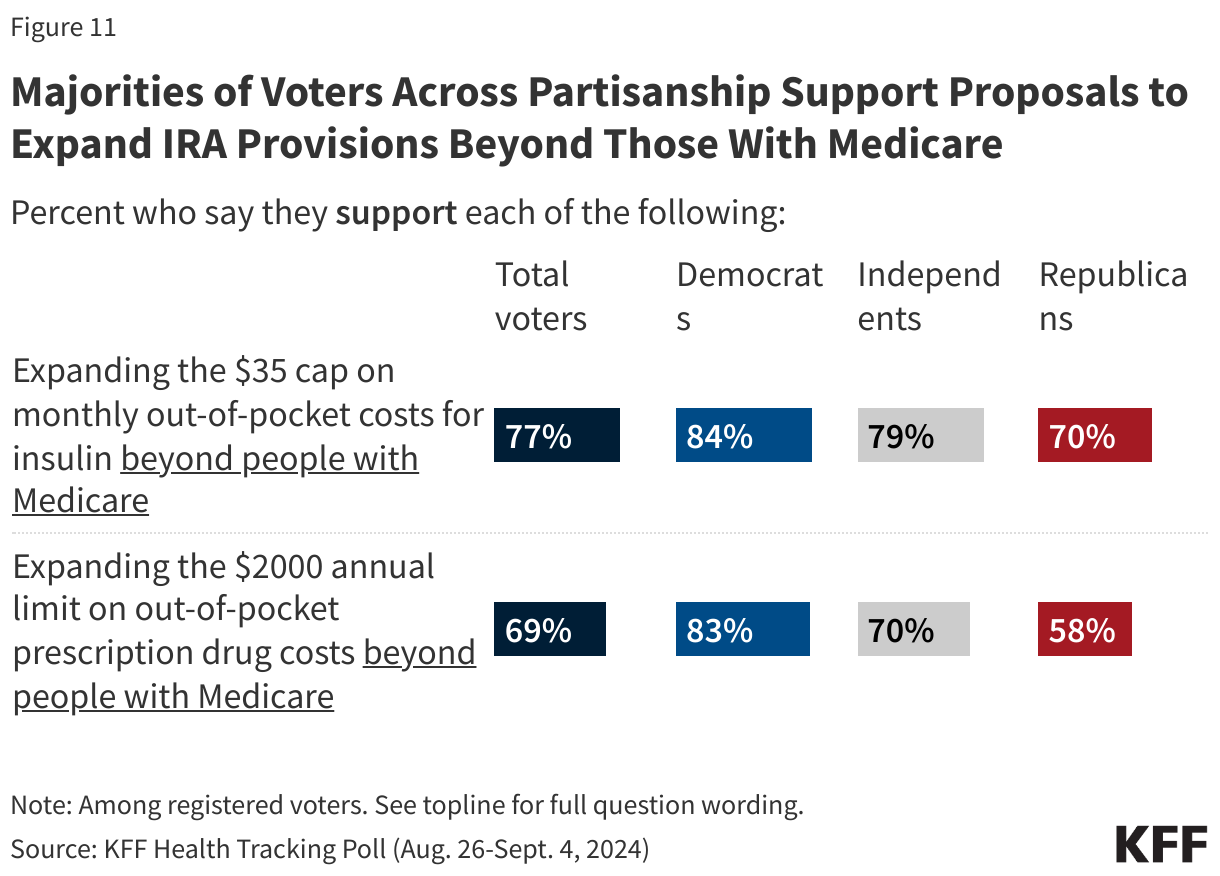
It is also notable that bipartisan support for the IRA provisions has held since its passage, and majorities across partisan lines support expanding what the law currently does. KFF polling from 2024, during the Biden administration, showed that at least eight in ten (85%) U.S. adults supported authorizing the federal government to negotiate drug prices for people with Medicare as the IRA does. This provision was supported by 90% of Democrats, 87% of independents, and 79% of Republicans.
In 2024, majorities across partisanship also supported expanding two IRA provisions beyond those covered by Medicare. Three in four adults supported a proposal to expand the $35 cap on out-of-pocket costs for insulin beyond those with Medicare, including majorities of Democrats (82%), independents (78%), and Republicans (67%). About two-thirds supported a proposal to expand the $2,000 annual limit on out-of-pocket prescription drug costs beyond those with Medicare, including 78% of Democrats, 69% of independents, and 57% of Republicans.
Trump Administration Policy Actions on Prescription Drug Prices, TrumpRx and Direct Purchasing Options
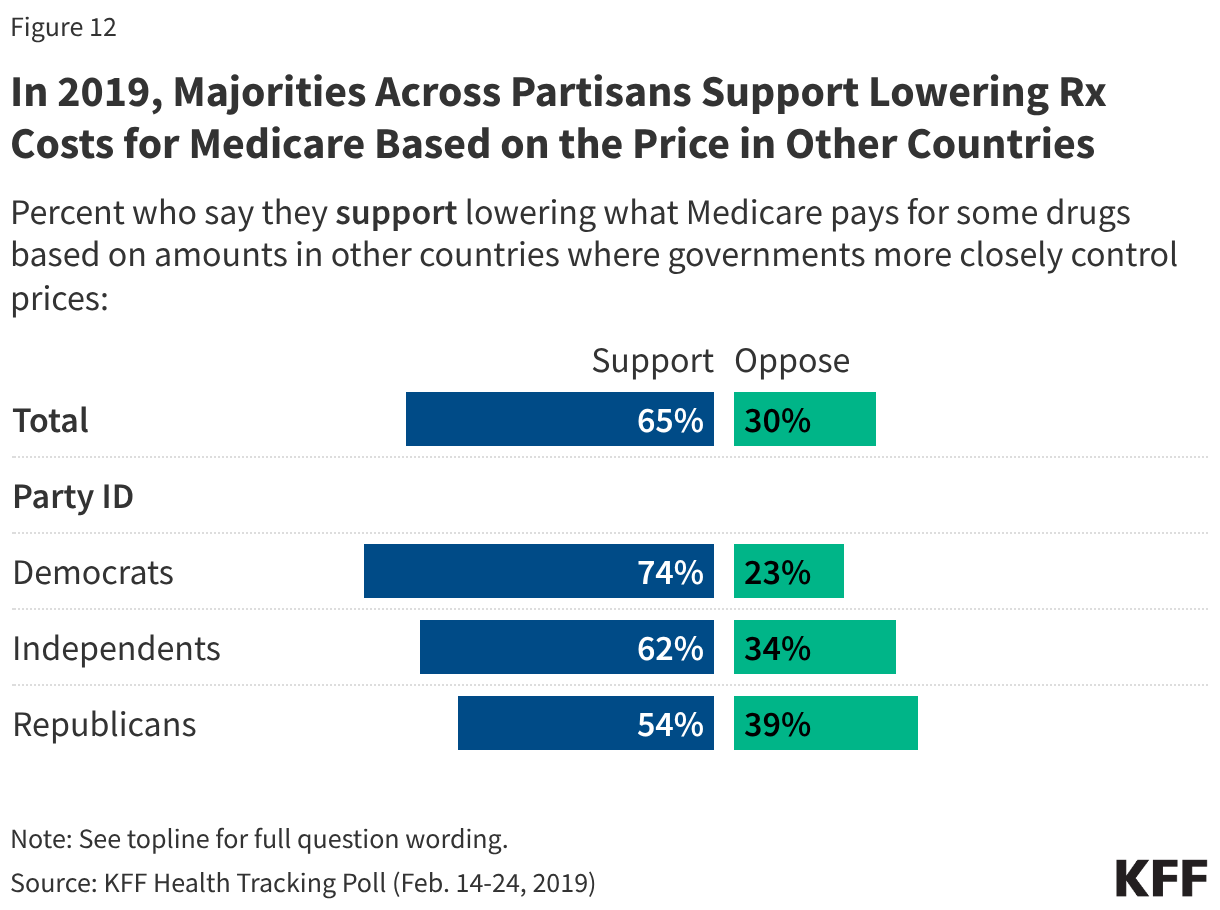
President Trump first pushed to lower prescription drug costs in the U.S. to match prices in other developed nations, during his first term in 2018, an approach that later became formally known as “most-favored-nation” (MFN) pricing. While this was not put into effect during Trump’s first term, KFF polling from 2019 found broad public support for the approach, with about two-thirds (65%) of adults supporting lowering what Medicare pays for some drugs based on amounts in other countries where governments more closely control prices. This includes most Democrats (74%), independents (62%), and Republicans (54%).
In the Trump administration’s second term, there have been more efforts to reduce the cost of prescription drugs. Though the details of the deals are confidential and not available to the public, the administration announced several prescription drug pricing deals with drugmakers related to what they charge state Medicaid programs for some of their drugs, and a subsequent deal with a maker of in vitro fertilization (IVF) drugs aimed at lowering the cost of these treatments. As of November 2025, awareness of these deals was limited, with three in ten adults saying they had heard a lot (6%) or some (25%) about them. Later in 2025, the president announced further developments in the MFN pricing, including deals to sell certain products directly to consumers at discounted rates.
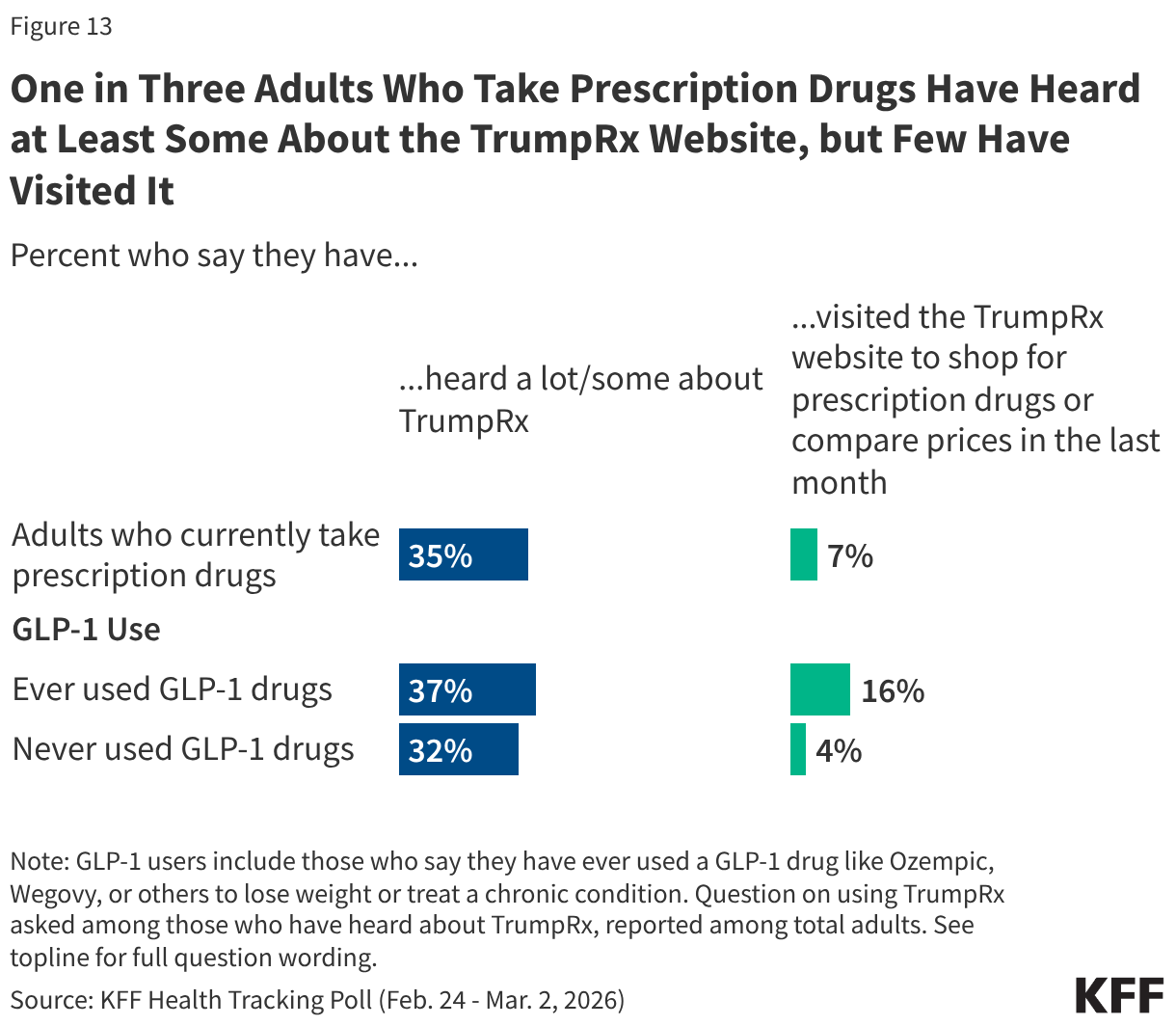
In February 2026, amid the Trump administration’s focus on lowering prescription drug costs, the administration officially launched TrumpRx, the federal government-run website where people can get discounts to buy prescription drugs directly from some manufacturers or pharmacies, without using their health insurance. As of early March 2026, few U.S. adults overall, including those who take prescription drugs, have heard much about or visited the website.
While few prescription drug users (7%) say they have visited the TrumpRx site to shop for or compare prescription prices in the month following the TrumpRx launch, this rises to about one in six (16%) among those who currently take or have ever taken a GLP-1 medication for weight loss or certain chronic conditions. The TrumpRx website features at least four major GLP-1 medications among its initial 43 listed drugs.
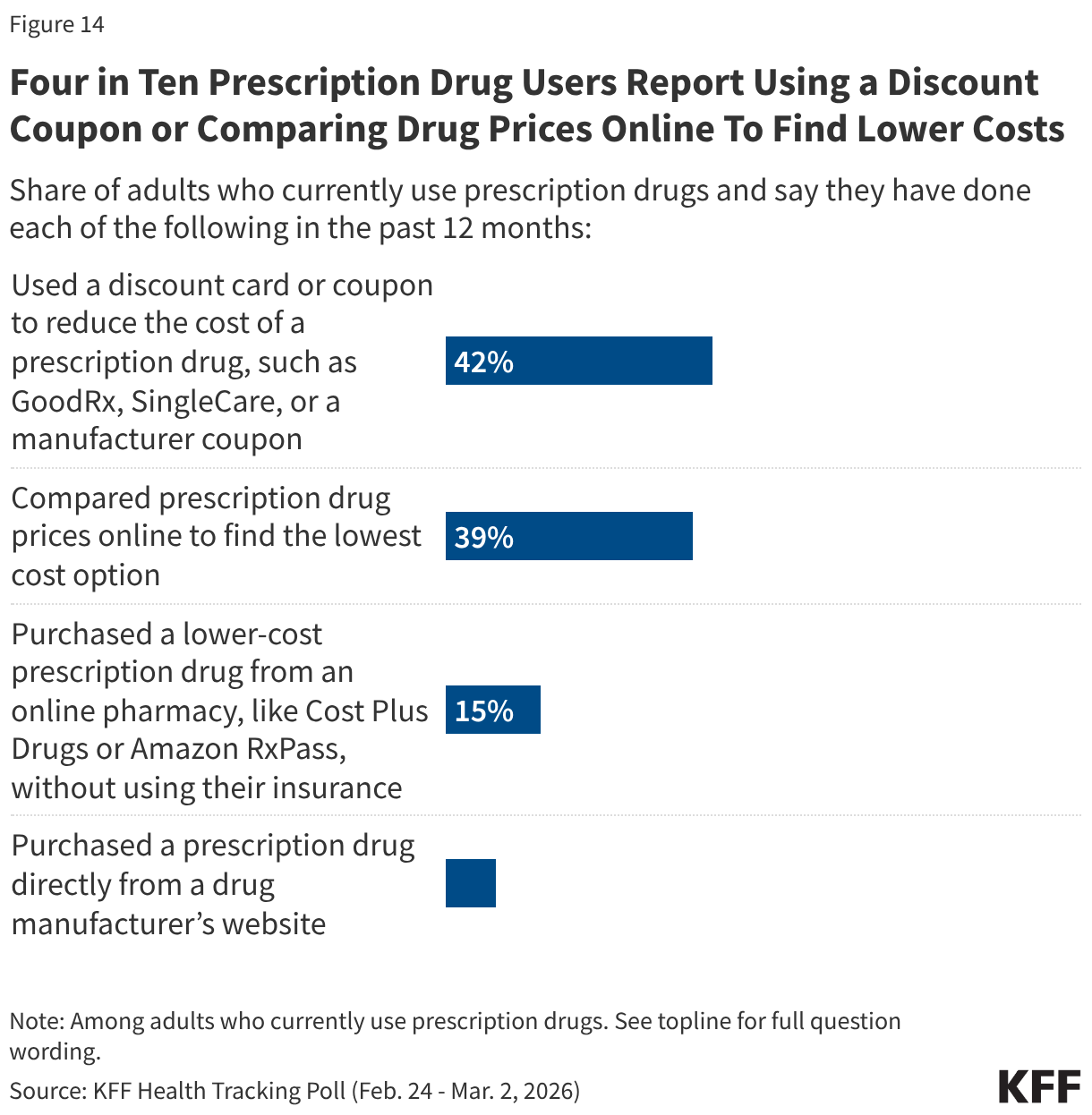
Prior to the launch of TrumpRx, drug discounts have been available through third-party platforms and directly from drug manufacturers. About four in ten adults who take prescription drugs say that in the past year, they have used a discount card or coupon to reduce their prescription drug costs (42%) or compared prescription drug prices online to find the lowest cost option (39%). Fewer say they have purchased a lower-cost drug from an online pharmacy without their insurance (15%) or directly from a drug manufacturer’s website (8%).