
Medicare Advantage Plan Availability Varies Widely by County for 2027
One in five (20%) Medicare beneficiaries have more than 40 Medicare Advantage drug plan options, while 1% of beneficiaries have none.
Editorial Note: This analysis, originally published on October 9, 2026, has been updated with additional data, including which firms have entered and exited the Medicare Advantage market overall, the number of firms the average beneficiary can choose from, and the distribution of beneficiaries by the number of firms offering plans across counties.
The Medicare Advantage market, the private plan alternative to traditional Medicare, is dynamic, and plan offerings can change from year to year. With 28 Medicare Advantage prescription drug (MA-PD) plans available to the average beneficiary in 2027, most people with Medicare have a robust set of MA-PD options. However, Medicare Advantage plans are offered at the county level, and variation in plan availability across the country has long been a feature of the Medicare Advantage market. This analysis uses Medicare plan landscape data from the Centers for Medicare & Medicaid Services to examine county-level variation in MA-PD plan availability in 2027 and changes from 2026. This analysis does not examine changes in costs, benefits, or other plan characteristics. The analysis shows that plan level availability varies widely across the country in 2027, with a modest reduction in the share of enrollees having more than 40 MA-PDs to choose from compared to 2026, some major insurers exiting a much larger number of counties than they are entering, and a larger number of firms exiting the market than the number of new entrants.
Findings
One in five Medicare beneficiaries (20%) can choose from more than 40 MA-PDs for coverage in 2027.
The 20% of Medicare beneficiaries who have more than 40 MA-PD options are concentrated in 4% of counties (Figure 1). This is a decrease from 2026 when 27% of beneficiaries, who resided in 6% of counties, had more than 40 options.Similar to 2026, the counties with the most plan options are predominantly in Pennsylvania, Ohio, and Michigan, as well as Los Angeles County, California. Beneficiaries in Lancaster, Pennsylvania can choose from 66 MA-PDs – the most offerings of any county in the U.S.
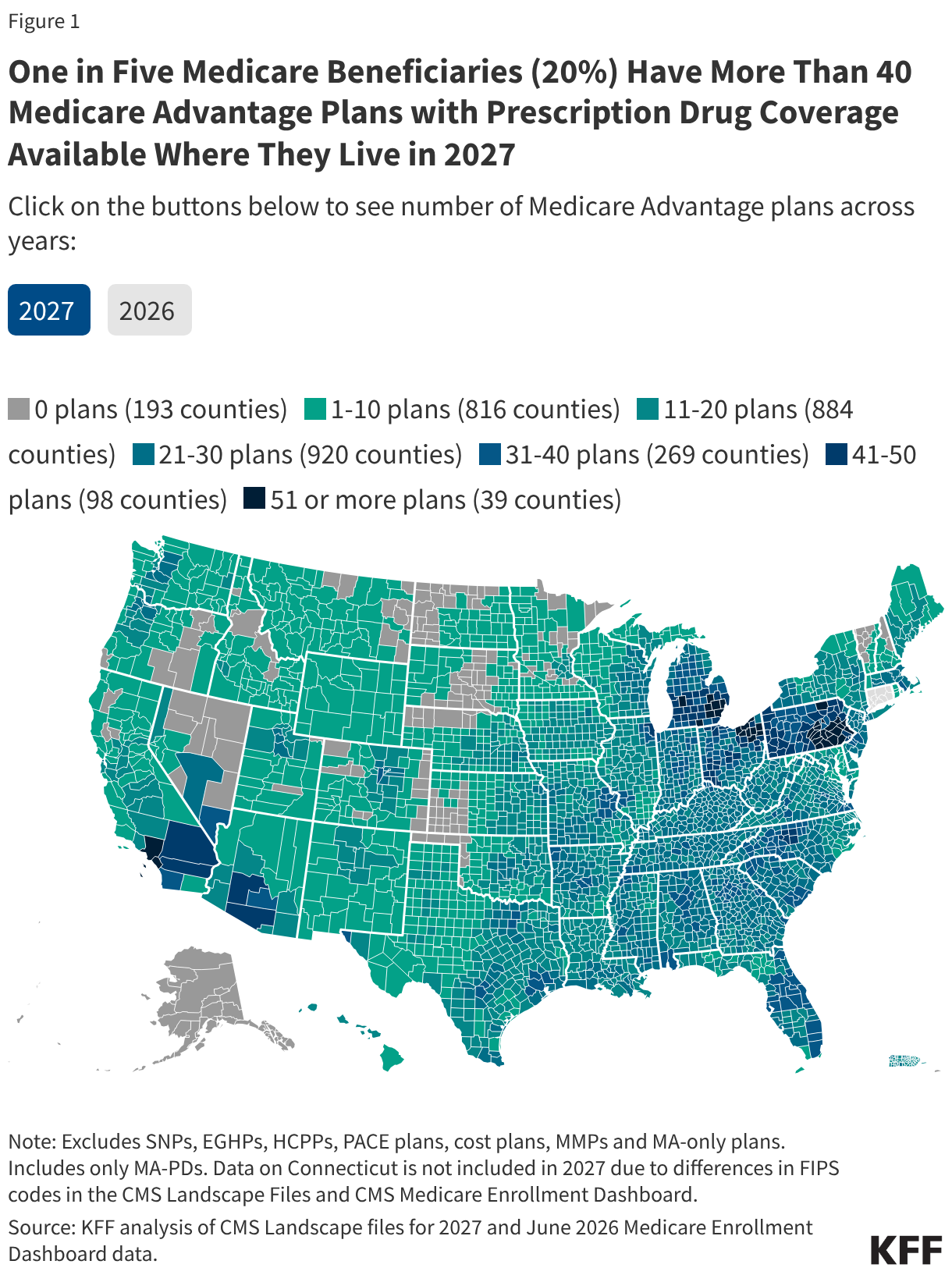
Nearly 13 million people have a choice of more than 40 Medicare Advantage plans with drug coverage for 2027, down from 16.6 million for the 2026 plan year. Another 12.8 million beneficiaries have a choice of 31 to 40 plans for 2027, down slightly from 13.2 million for 2026. In contrast, nearly 7 million people have 1 to 10 Medicare Advantage plans with drug coverage available for 2027, up from 4.8 million people for the 2026 plan year.
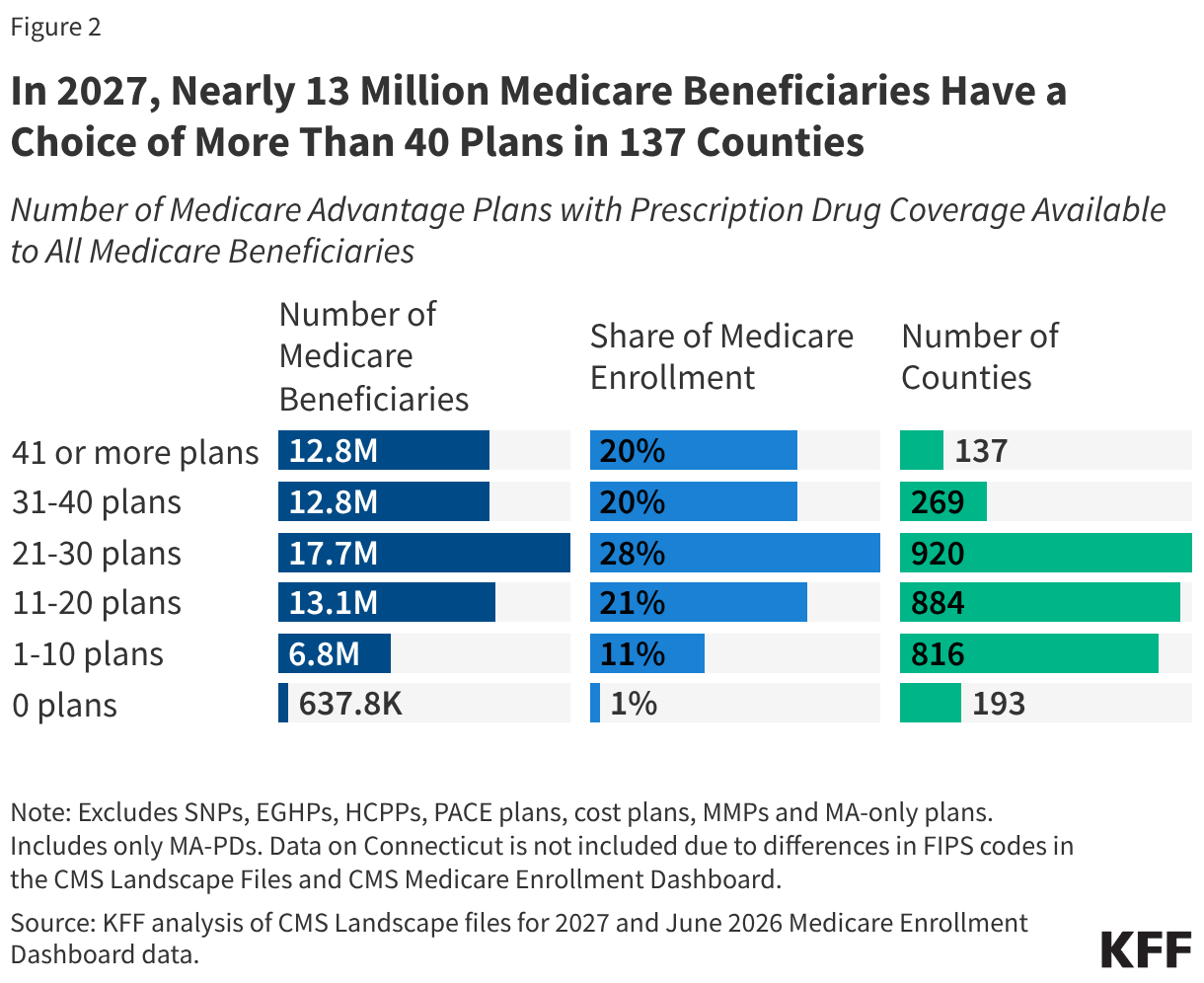
For 2027, Medicare beneficiaries residing in 193 counties will have no MA-PDs available for general enrollment, an increase from 123 counties in 2026.
Beneficiaries in the 193 counties without any MA-PD option for general enrollment for 2027 comprise 1% of all Medicare beneficiaries, or 638,000 people. This is an increase from 2026, when 399,000 beneficiaries did not have a MA-PD option (an increase of 239,000 beneficiaries).
The counties with no MA-PD options are located in 16 states (Alaska, California, Colorado, Idaho, Kansas, Minnesota, Montana, Nebraska, Nevada, New Hampshire, North Dakota, Oklahoma, Oregon, South Dakota, Utah, and Vermont) and U.S. territories other than Puerto Rico. These are the same states as 2026, with the addition of New Hampshire, North Dakota, and Oklahoma. Similar to 2026, there are no MA-PDs for general enrollment being offered in any county in Alaska in 2027, which includes about 110,000 beneficiaries.
In six counties (Boyd, Nebraska; Aurora, Beadle, Bon Homme, Brown, and Charles Mix, South Dakota) there is a Medicare Advantage plan option without prescription drug coverage, but in the other 187 counties, no Medicare Advantage plans with or without prescription drug coverage for general enrollment are available. In some counties where Medicare Advantage plans for general enrollment are not available, there are other private plan options, including cost plans as well as special needs plans, which restrict enrollment to Medicare beneficiaries who meet specific criteria.
The average Medicare beneficiary can choose from among MA-PDs offered by seven firms for 2027.
The average Medicare beneficiary can choose from Medicare Advantage prescription drug plans offered by seven firms for 2027, a decline of one firm from the 2026 plan year. Despite most beneficiaries having access to plans operated by several different firms, enrollment is concentrated in plans operated by UnitedHealthcare and Humana, which together account for nearly half (46%) of Medicare Advantage enrollment in 2026.
For 2027, two in ten beneficiaries (20%), in 68 counties, are able to choose from MA-PDs offered by 10 or more firms (a decline from 29% of beneficiaries in 131 counties for the 2026 plan year; Figure 3).
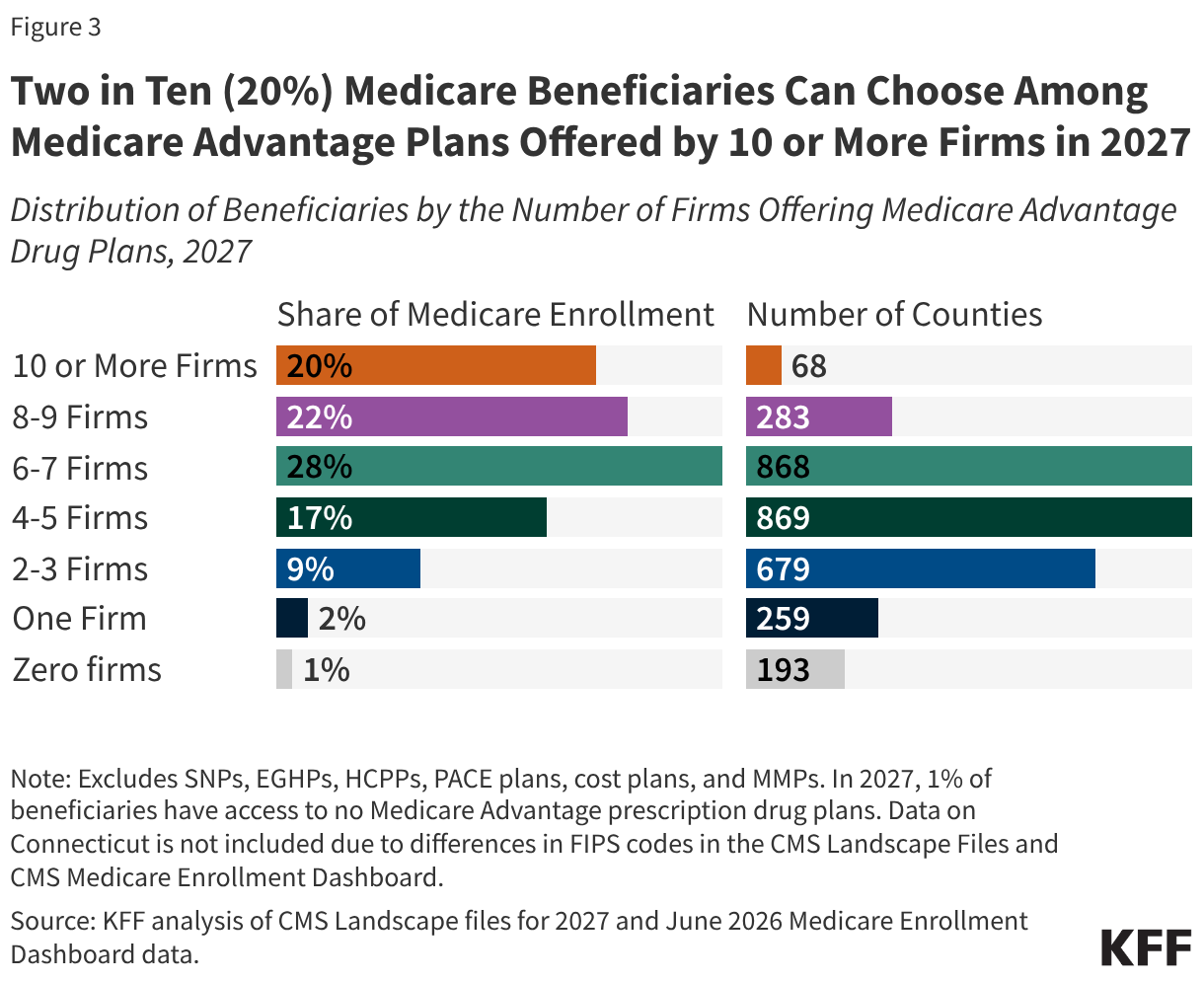
In contrast, about 9% of beneficiaries, in 679 counties, can choose from MA-PDs offered by two or three firms (an increase from 572 counties and 7% of beneficiaries for the 2026 plan year). Further, in 259 counties, only one firm will offer an MA-PD for 2027, an increase from 180 counties for the 2026 plan year. These are mostly rural counties with relatively few Medicare beneficiaries (about 2% of the Medicare population for 2027, a slight increase from 1% of the population for the 2026 plan year).
The two largest Medicare Advantage insurers – UnitedHealth Group and Humana – are exiting more counties, meaning they are no longer offering any MA-PDs in those counties, than they are entering in 2027.
UnitedHealth Group is exiting 228 counties and entering 9 new counties, and Humana is exiting 62 counties and entering 4 new counties (Figure 4). Humana is offering MA-PDs in the largest number of counties relative to other insurers – about 80% of all U.S. counties, similar to 2026 – while UnitedHealth Group is offering plans in about 70% of counties, a decline from 2026, when the insurer offered plans in nearly 80% of counties.
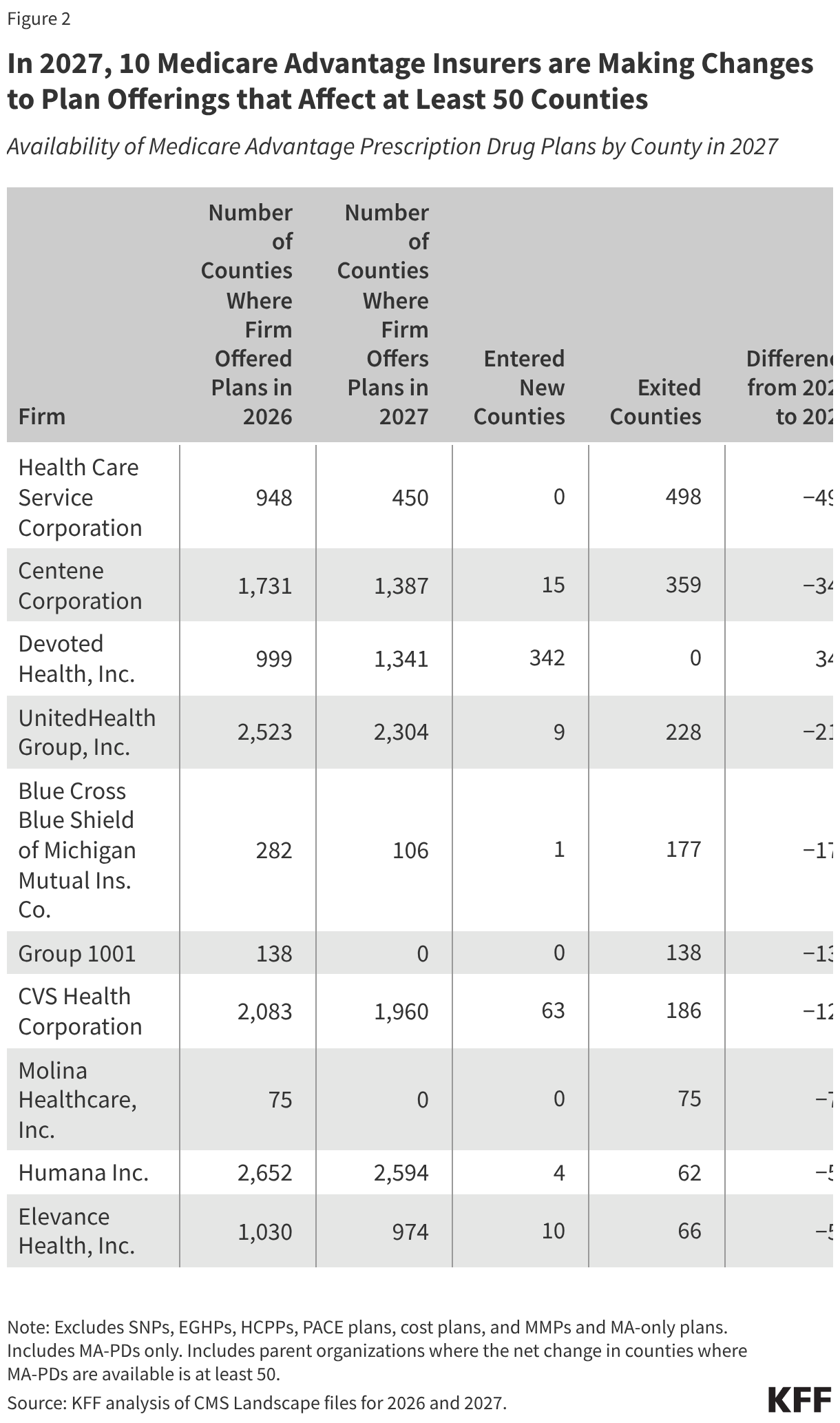
Among insurers offering MA-PD plans, Health Care Service Corporation is making the largest reduction in its county footprint, exiting the greatest number of counties in 2027 (498 counties) while entering no new counties. Centene has the second largest reduction, exiting 359 counties and entering 15 new counties for 2027. Blue Cross Blue Shield of Michigan Mutual Ins. Co., which had offered MA-PDs in Iowa, Michigan, North Dakota, South Dakota, and Wyoming in 2026, is exiting 177 counties and entering one new county, and will only offer MA-PDs in Michigan and Wyoming for 2027. Elevance Health is exiting 66 counties and entering 10 new counties in 2027.
Two insurers - Group 1001 (marketed as Clear Spring Health), which offered plans in Colorado, Georgia and Illinois, and Molina Healthcare – are completely exiting the MA-PD market, though Molina is still offering SNPs in many counties in 2027.
In contrast, Devoted Health is expanding its MA-PD footprint, entering 342 counties and exiting none in 2027. Second to Devoted Health, CVS Health is entering a larger number of new counties in 2027 than other insurers (63 new counties), but is also exiting 186 counties.
Kaiser Foundation Health Plans, a high enrollment insurer, is maintaining its footprint, exiting three counties while entering three new ones in 2027 (data not shown).
The characteristics of markets that insurers are leaving vary. In some cases, multiple insurers are exiting more rural areas with relatively small Medicare populations, such as four counties in Minnesota (Brown, Lake of the Woods, Morrison, and Renville), in each of which three insurers who offered MA-PDs in 2026 are no longer offering MA-PDs for 2027. In other cases, individual insurers are exiting counties in more urban areas with higher Medicare Advantage penetration, such Miami-Dade County, FL where Health Care Service Corporation is no longer offering MA-PDs in 2027 and Monroe County, New York (Rochester) where Humana left the market. The different decisions of insurers to exit certain counties suggest a combination of factors are at play, including local market characteristics, cost pressures, shifts in firm-level strategies, and ultimately the insurers’ assessment of profitability.
In 2027, more firms are exiting the Medicare Advantage market than entering it.
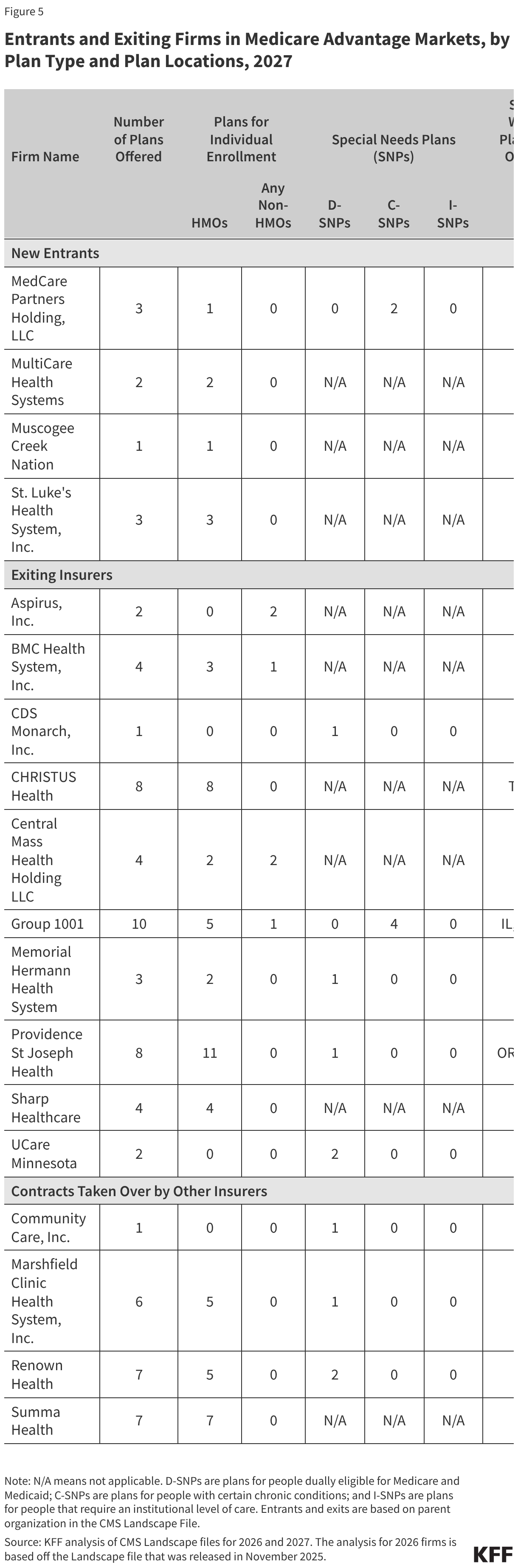
In 2027, four firms are entering the Medicare Advantage market for the first time, ten firms are exiting the market, and four have had contracts taken over by other insurers (Figure 10). Three of the four firms entering the market are offering only HMO plans, while one firm is offering both HMOs and C-SNP plans.
In recent years, some firms have introduced plans that are either co-branded or are in partnership with another company. For example, Alignment Health is offering plans co-branded with Instacart in California and Nevada in 2027, as they did in 2026 and 2025. These plans will offer groceries to qualifying beneficiaries with chronic conditions. Alignment Health also continues to partner with Walgreens, and Humana continues to partner with USAA. New for 2027, SCAN Group is offering co-branded plans with Costco in California and Nevada as well as plans with Walmart in Arizona and Texas.
Ten firms that participated in the Medicare Advantage market in 2026 are not offering plans in 2027. Some of the firms, such as Memorial Hermann Health Plan and Central Mass Health (Mass Advantage) cited specific reasons for exiting the market, such as the changing Medicare landscape, cost pressures, and regulatory uncertainty, but others often do not specify why they are leaving the market.
Another four firms left the market but had their contracts taken over by other insurers, typically through a merger or affiliation. Three of the firms that are no longer in the Medicare Advantage market had contracts taken over by other parent organizations that were already offering plans in the Medicare Advantage market (Community Care, Inc., Marshfield Clinic Health System, Inc., and Renown Health). Summa Health plans are now part of General Catalyst Group Management Holdings LP, which is new to the Medicare Advantage market.
While they are not exiting the Medicare Advantage market completely, an additional four firms that had previously offered Medicare Advantage prescription drug plans available for general enrollment will only be offering SNPs in 2027 (Elderplan, Inc., Horizon Mutual Holdings, Inc, Molina Healthcare, Inc, and Presbyterian Healthcare Services).