
Key Facts About Medigap Enrollment and Premiums for Medicare Beneficiaries
Introduction
Medicare currently provides health insurance coverage to more than 70 million people in the U.S. However, people with Medicare can face substantial cost-sharing requirements for Medicare-covered services, and unlike most other types of health insurance, coverage under traditional Medicare provides no cap on out-of-pocket spending. While more than half of Medicare beneficiaries are currently enrolled in Medicare Advantage plans, which are required to have an out-of-pocket cap, 28.2 million beneficiaries are enrolled in traditional Medicare and lack this same automatic protection. Many Medicare beneficiaries have modest incomes and little savings to draw on if they incur substantial medical expenses.
To fill this gap in coverage under traditional Medicare, the Medicare supplement insurance market, also known as Medigap, plays a key role in enhancing the affordability of medical care for beneficiaries in traditional Medicare by helping policyholders pay their Medicare cost-sharing requirements and by limiting their exposure to catastrophic out-of-pocket medical costs.
This brief presents facts about Medigap, including the characteristics of Medicare beneficiaries with a Medigap policy, variation in Medigap enrollment by state, and Medigap premiums. This analysis is based on data from the National Association of Insurance Commissioners (NAIC) compiled by Mark Farrah Associates (MFA), through the end of 2025 (the most recent year of annual data) and the Centers for Medicare & Medicaid Services (CMS) Medicare Current Beneficiary Survey 2024 Survey File data. See methods for more information. A companion brief: Medigap Guaranteed Issue Requirements: An Overview of Federal and State Rules analyzes federal and state guaranteed issue rules and how they impact beneficiaries’ access to Medigap and another brief, Nearly Three-Quarters of Medicare Advantage Enrollees Could be Denied a Medigap Policy Due to a Pre-Existing Condition, analyzes the share of Medicare Advantage enrollees who could be denied a Medigap policy due to having a pre-existing condition.
Key Takeaways
- In 2024, 12.9 million, or just under half (46%) of people in traditional Medicare had a Medigap policy. Compared to all traditional Medicare beneficiaries in 2024, traditional Medicare beneficiaries with a Medigap policy are more likely to be White, have higher incomes, report better health and be 65 and older. Among traditional Medicare beneficiaries, a smaller share of beneficiaries under age 65 with disabilities have a Medigap policy compared to beneficiaries ages 65 and older (8% vs 50%), due in part to a lack of Medigap guaranteed issue protections under federal law for those under age 65.
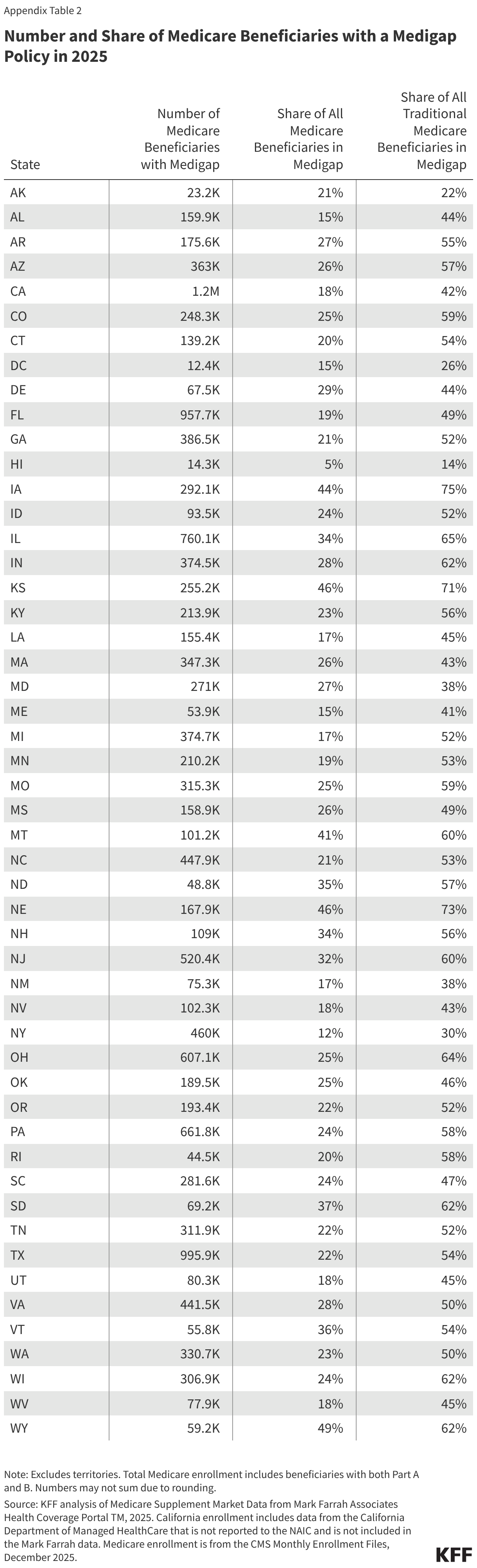
- The share of traditional Medicare beneficiaries with Medigap varies by state, ranging from 14% in Hawaii to 75% in Iowa.
- Of the 10 standardized Medigap policy types, Medigap Plan G, which is the most comprehensive Medigap policy available to newly eligible Medicare beneficiaries, was the most popular plan type in 2025, accounting for 46% of all policyholders, or 6.3 million people. Part F, which has the same benefits as Plan G but also covers the Part B deductible, has the second largest share of Medigap policyholders in 2025 (30% or 4.2 million people), but it has not been available to newly eligible beneficiaries since 2020.
- The average monthly premium among current Medigap policyholders was $244 in 2025, or $2,926 for a full year of coverage.
- Medigap premiums vary by state and by policy type. For example, in 2025, the average monthly premium for people enrolled in Plan G was $194 ($2,323 for 12 months), but this varied from $164 in New Mexico to $257 in New York.
- On average, Medigap premiums among current policyholders increased 7% between 2024 and 2025, and 20% over the five years between 2020 and 2025. These increases translated to an additional $192 annually between 2024 and 2025, and $492 more in total between 2000 and 2025. But the increase for Plan G was higher – 13% more on average between 2024 and 2025 and a 38% increase between 2020 and 2025.
Overview of Medigap
Medicare beneficiaries can choose to get their Medicare Part A and B benefits through the traditional Medicare program or a Medicare Advantage plan. Medicare Advantage plans are private plans that cover Medicare Part A and B benefits and typically also the Part D prescription drug benefit. Among the nearly 62 million people enrolled in Medicare Part A and B in 2024, slightly less than half (45%, or 27.8 million) of Medicare beneficiaries were in traditional Medicare. Most traditional Medicare beneficiaries have some form of additional coverage that helps to cover Medicare’s cost-sharing requirements, such as Medigap, employer-sponsored retiree benefits, or Medicaid, but 2.9 million beneficiaries lack any source of additional coverage.
Medigap is private supplemental health insurance that helps people with traditional Medicare cover Medicare Part A and Part B cost-sharing requirements, including deductibles, copayments, and coinsurance. (Medigap does not work with Medicare Advantage.) Medigap is the primary source of supplemental insurance for people in traditional Medicare without employer-sponsored retiree benefits or Medicaid. In 2024, 12.9 million Medicare beneficiaries, or 46% of all traditional Medicare beneficiaries, had a Medigap policy.
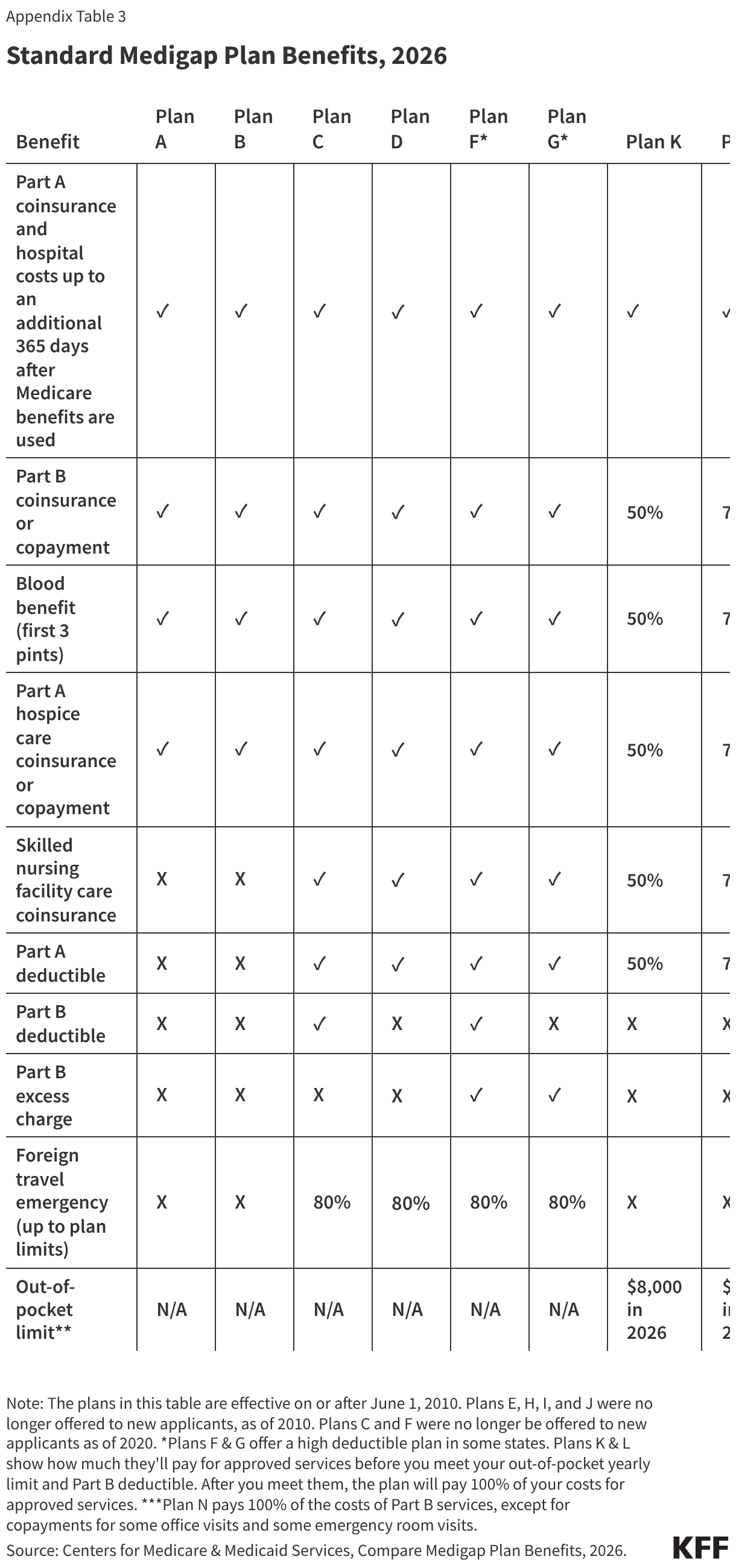
By helping to cover Medicare’s cost-sharing requirements, Medigap insurance limits the financial exposure of Medicare beneficiaries and provides protection against catastrophic expenses for Medicare-covered services. There are different types of Medigap policies that provide different levels of cost-sharing assistance (see Appendix Table 3). Medigap policies also make health care costs more predictable by spreading costs over the course of the year through monthly premium payments and reduce the paperwork burden for beneficiaries associated with medical bills.
Characteristics of People with Medigap
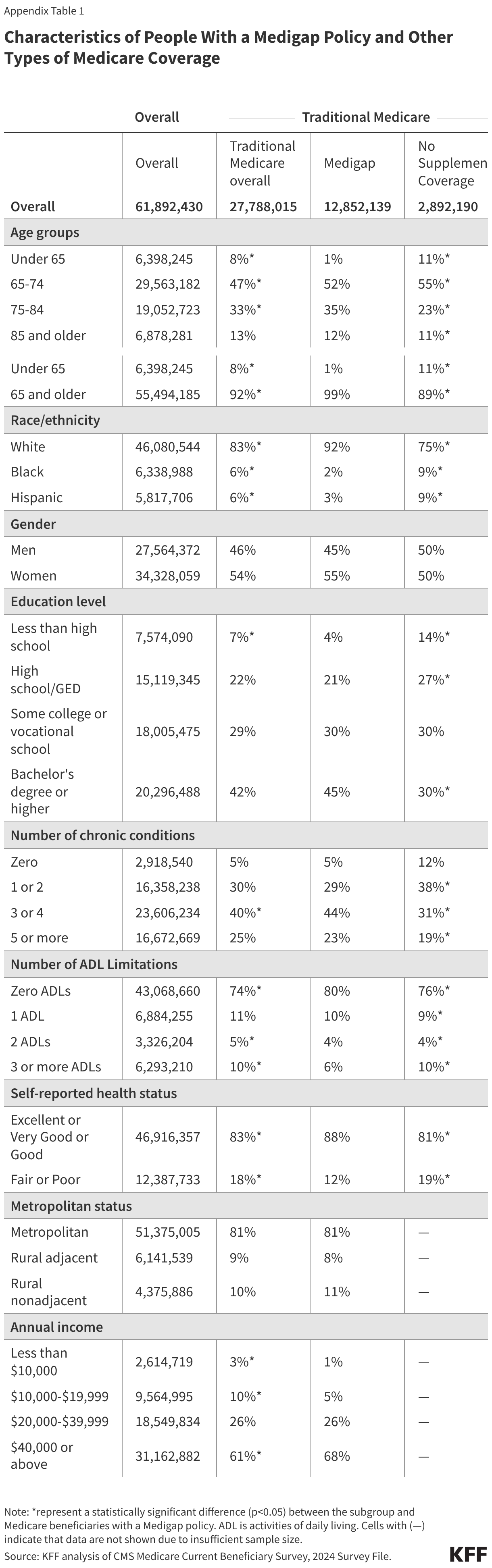
A larger share of traditional Medicare beneficiaries with Medigap than traditional Medicare beneficiaries overall are White (92% vs 83%), have incomes of $40,000 or above (68% vs 61%), report their health as excellent, very good, or good (88% vs 82%), and are ages 65 and older (99% vs 91%) (Figure 1; See Appendix Table 1 for a comparison of characteristics of Medigap enrollee to beneficiaries with other types of coverage).
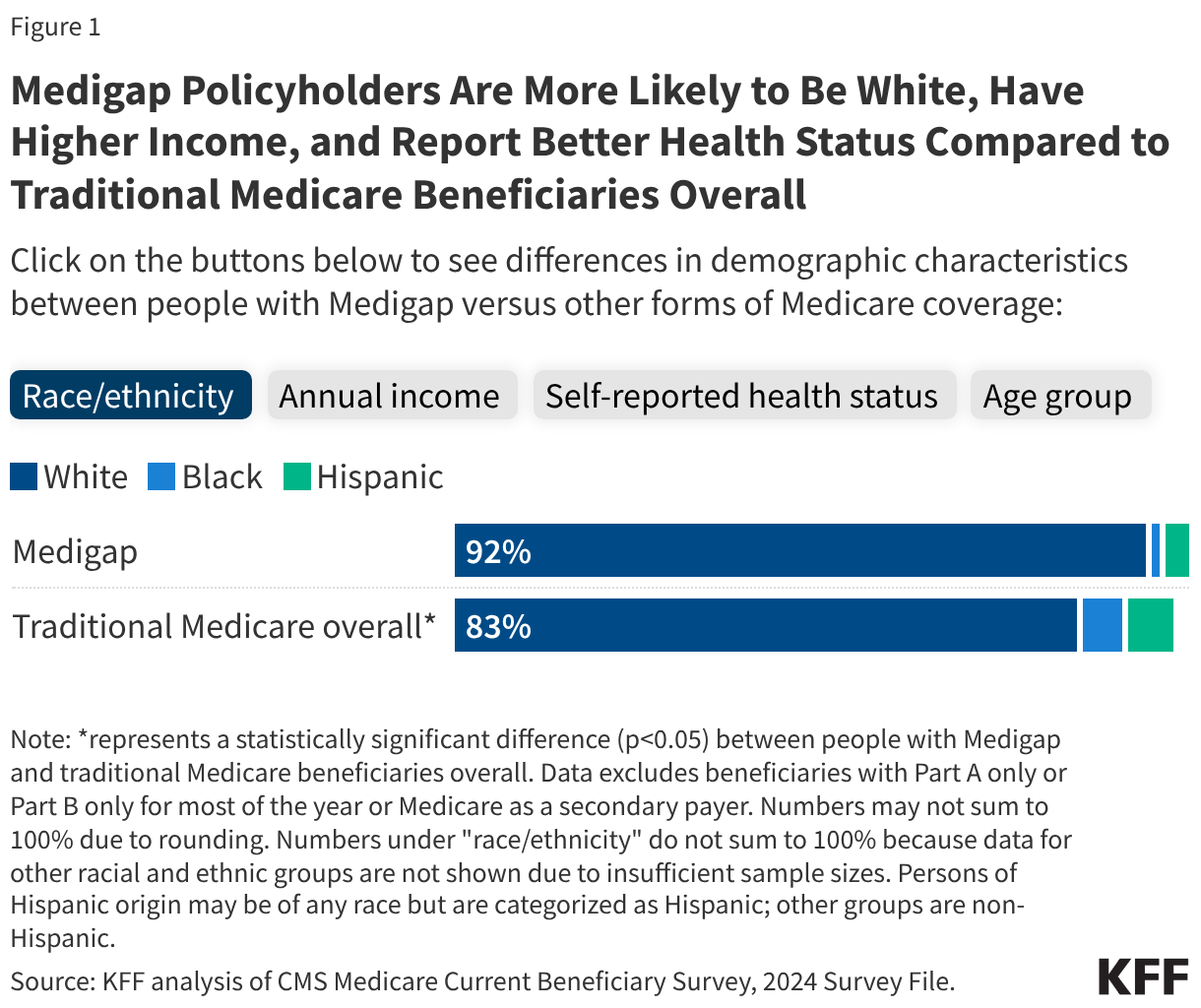
Federal law offers a one-time, six-month Medigap open enrollment period for beneficiaries ages 65 and older when they age onto Medicare. However, this guaranteed issue right does not extend to Medicare beneficiaries under age 65 who qualify for Medicare on the basis of having a long-term disability. Because Medicare beneficiaries under age 65 may have difficulty purchasing a Medigap policy, a much smaller share of traditional Medicare beneficiaries under age 65 and older have a Medigap policy compared with people age 65 and older (6% versus 47%).
Most states (38 states) go beyond federal law and require Medigap insurers to offer at least one policy to people under age 65 during an initial open enrollment period, but premiums in these states vary and may be higher for people under age 65 (see section below Premium Rules Vary Across States That Require Insurers to Offer at Least One Medigap Policy Type to People Under Age 65 for more details).
Additionally, Medigap premiums can be costly (as discussed in more detail in the section below Premiums Vary Across Medigap Policies), making it more difficult for people with lower incomes to afford a Medigap policy. This, along with higher rates of supplemental coverage under Medicaid, could be a factor in lower rates of enrollment of Black and Hispanic Medicare beneficiaries in traditional Medicare plus Medigap compared to Medicare Advantage (see Appendix Table 1), since Black and Hispanic beneficiaries have lower income and assets compared to White beneficiaries. Black and Hispanic beneficiaries are also more likely to report relatively poor health and have higher prevalence rates of certain chronic conditions that would be classified as pre-existing conditions by Medigap insurers, which could also make it difficult for individuals in these groups to obtain Medigap, particularly outside of guaranteed issue periods when medical underwriting is not allowed.
Medigap Enrollment Varies by State
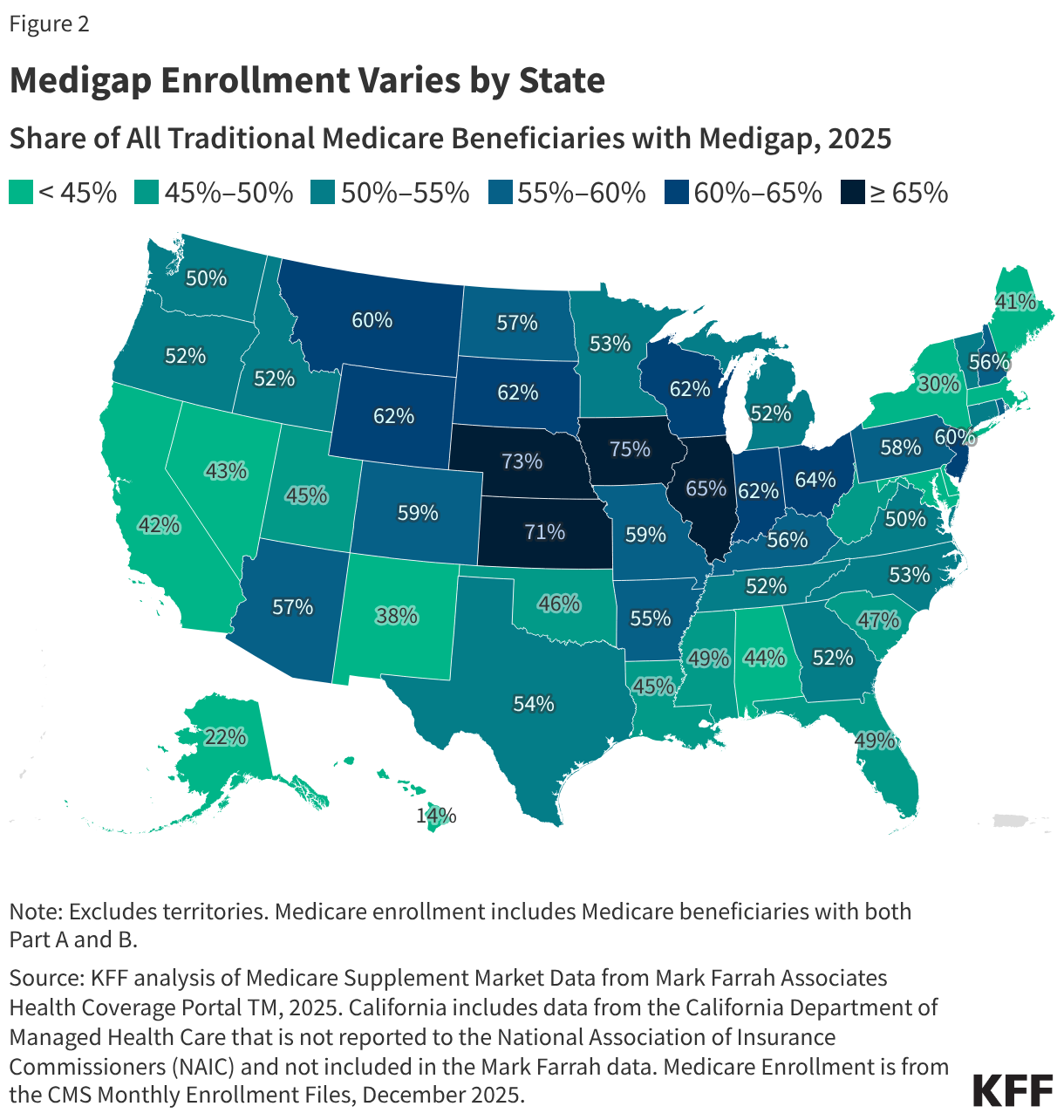
Medigap enrollment varies widely by state: from 14% of traditional Medicare beneficiaries in Hawaii to 75% in Iowa, based on KFF analysis of 2025 NAIC data (Figure 2, Appendix Table 1). In eleven states, 60% or more of Medicare beneficiaries with coverage of both Part A and B under traditional Medicare have a Medigap policy.
Medigap Provides Varying Levels of Coverage of Medicare Cost Sharing Depending on the Policy Type
There are 10 different types of Medigap policies (labeled A through N), each having a different, standardized set of benefits (Appendix Table 3).
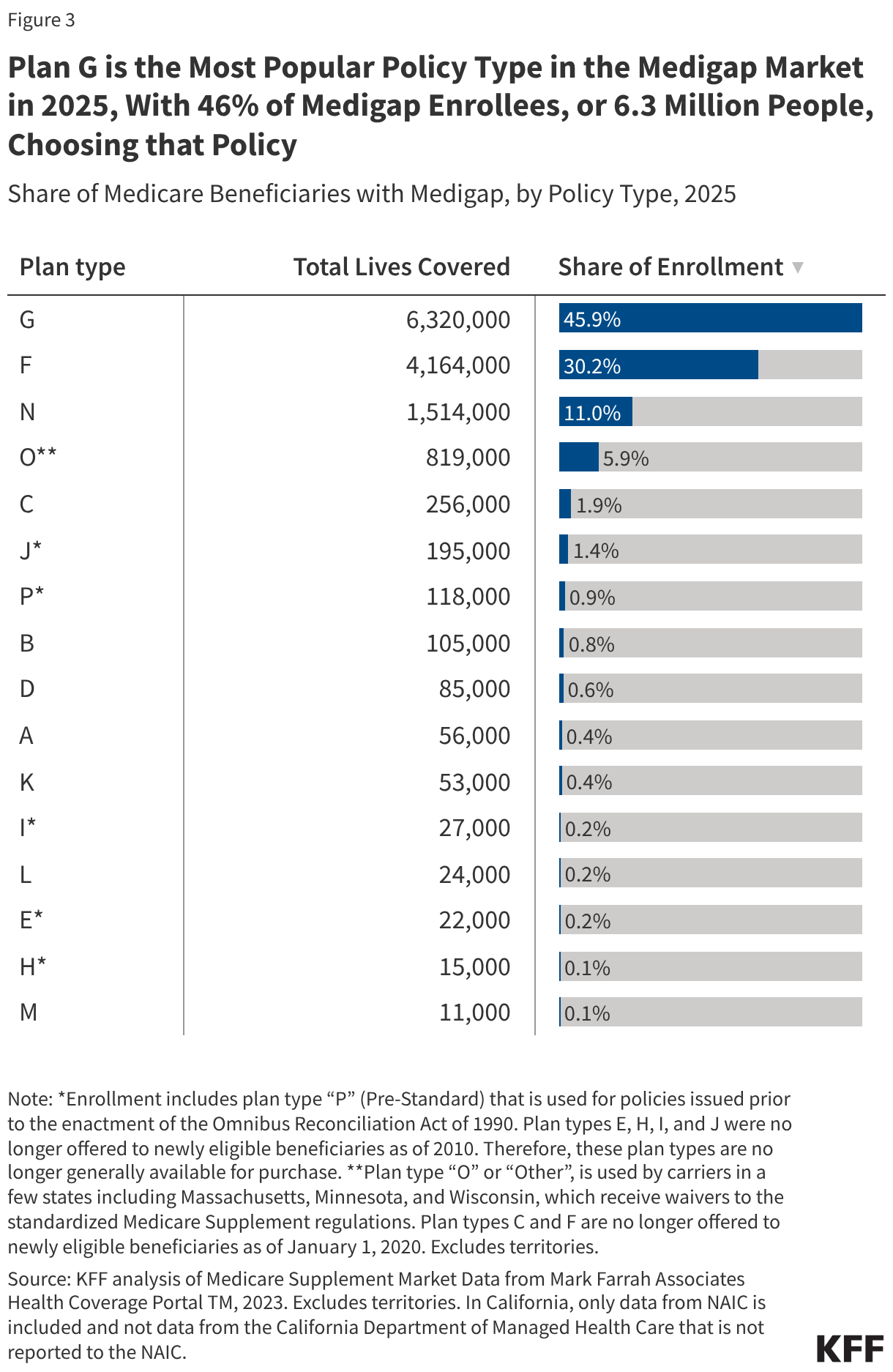
Plan G is the most popular Medigap policy, accounting for 46% of all policyholders, or 6.3 million people, in 2025 (Figure 3). Plan G is the most comprehensive policy available to newly eligible Medicare beneficiaries, covering the Part A deductible and all cost sharing for Part A and B covered services, but not the Part B deductible. Plan G has become the most popular plan since a change in law that prohibited Medigap policies from covering the Part B deductible for newly eligible beneficiaries, which meant that Plan C and Plan F could no longer be sold to new beneficiaries who turned 65 on or after January 1, 2020. Plan F has the second largest share of Medigap enrollment, covering 36% of Medigap policyholders or 4.2 million people. Plan N has the third largest share of Medigap enrollment, covering 10% of policyholders or 1.5 million people. Plan N is similar to Plan G, except that there are Part B copayments for some office visits and some emergency room visits, and it does not cover Part B excess charges.
Buying a Medigap Policy is Generally Limited to Specified Time Periods and Circumstances
Federal Medigap Rules
Federal law provides guaranteed issue protections for Medigap policies during a one-time, six-month Medigap open enrollment period for beneficiaries ages 65 and older, which begins the first month of Medicare Part B coverage, as well as for certain qualifying events. Some of these qualifying events may include instances when people involuntarily lose certain types of supplemental coverage, such as when an employer cancels retiree coverage or when a Medicare Advantage plan discontinues coverage in their area. The federally guaranteed one-time, six-month Medigap open enrollment period does not extend to beneficiaries with long-term disabilities who qualify for Medicare before age 65.
Beneficiaries also have guaranteed issue rights during specified “trial” periods, such as the first year that people who are first eligible for Medicare Part A at 65 are enrolled in Medicare Advantage. During that time, beneficiaries can try a Medicare Advantage plan, and if they disenroll within the first year, they have guaranteed issue rights to purchase any Medigap policy that is sold in their state.
During these defined periods, Medigap insurers cannot deny a policy based on age, gender, or health status, vary premiums based on pre-existing conditions, or exclude coverage for pre-existing conditions. However, under federal law, Medigap insurers may impose a waiting period of up to six months to cover costs related to pre-existing conditions if the applicant did not have at least six months of prior continuous creditable coverage. For qualifying events that trigger guaranteed issue rights, people ages 65 and older in Medicare generally have 63 days to apply for a Medigap policy.
State-Level Medigap Rules
States can choose to establish Medigap rules that provide a greater level of consumer protection than the federal standards. Eight states have relatively generous continuous or annual guaranteed issue protections. Four states – Connecticut, Massachusetts, Maine, and New York – require Medigap insurers to offer policies either continuously throughout the year or once per year to Medicare beneficiaries age 65 and older without regard to their medical conditions. This guaranteed issue right extends to those who have been in traditional Medicare past their initial enrollment period and those in Medicare Advantage whose enrollment may have extended beyond the initial 12-month “trial right” period.
In addition, Rhode Island and Delaware enacted legislation in 2025 to institute annual guaranteed issue protections for people with Medicare Advantage to purchase a Medigap policy (though they do not apply to people with traditional Medicare who do not have a Medigap policy). In Delaware, while insurers cannot deny any Medigap application, they may charge higher premiums based on medical underwriting and impose a 6-month waiting period to cover services related to pre-existing conditions. Effective August 2026, Minnesota also began offering annual guaranteed issue protections for Medicare beneficiaries ages 65 to 70. Illinois insurer Blue Cross Blue Shield of Illinois also offers policies to anyone 65 and older who seeks to purchase a Medicare supplement on a guaranteed issue basis through the year, though this is not a statutory requirement and is potentially subject to change.
Other states have also expanded on the federal minimum standards to allow beneficiaries to purchase Medigap on a guaranteed issue basis after certain qualifying events or for beneficiaries under 65 with disabilities to purchase Medigap during an initial open enrollment period. (For more information on qualifying events and additional state-level Medigap protections, see Medigap Guaranteed Issue Requirements: An Overview of Federal and State Rules for more details.)
Premiums Vary Across Medigap Policies
Although Medicare is a federal program, Medigap policies are insurance products that are regulated at the state level, meaning states establish certain rules for Medigap insurers, including how to set premiums. Premiums may be based on factors such as a policyholder’s age, smoking status, gender, and residential area, even during open enrollment and guaranteed issue periods.
There are three different rating systems that can affect how Medigap insurers determine premiums: community rating, issue-age rating, or attained-age rating.
- Community rating: The same premium is generally charged to everyone, regardless of age or gender. Premiums may go up because of inflation and other factors, such as smoking status and residential area, but not due to age.
- Issue-age rating: The premium is based on the age of the beneficiary when they purchase the Medigap policy. Premiums are lower for people who buy at a younger age and higher for those who buy at older ages. Premiums may increase over time due to inflation and other factors, such as smoking status and residential area, but not due to age.
- Attained-age rating: The premium is based on a beneficiary’s current age, so the premium goes up as they get older. Premiums are lower for younger buyers but increase as they get older, which means that premiums may be the least expensive at first but can eventually become the most expensive. Premiums may also increase due to inflation and other factors, such as smoking status and residential area.
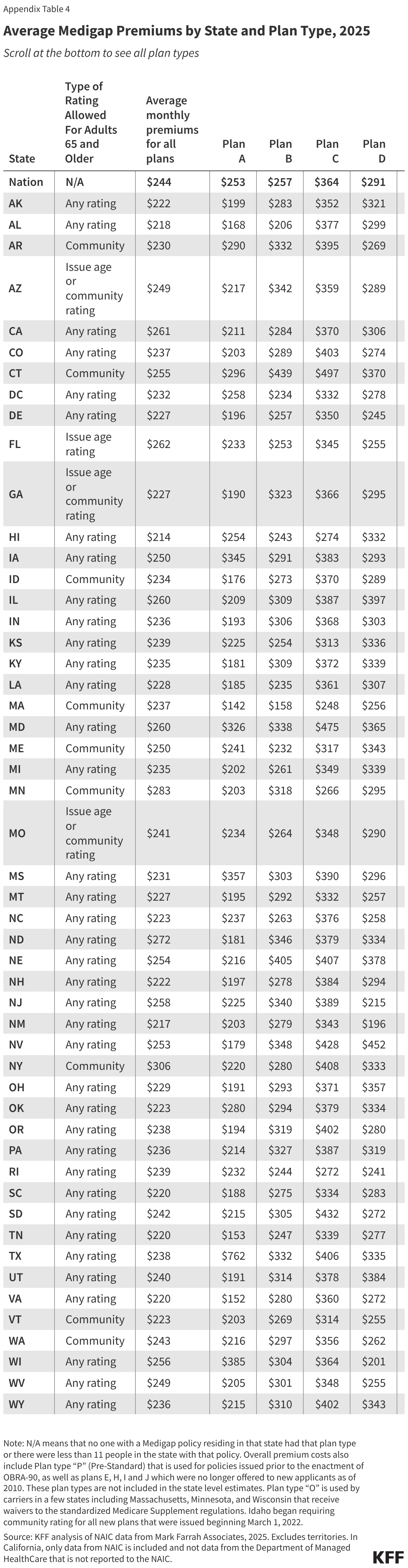
States can impose regulations on which of these rating systems are permitted or required for Medigap policies sold in their state. Currently, most states (37 states and D.C.) allow any rating system. Nine states (AR, CT, ID, MA, ME, MN, NY, VT, and WA) require premiums to be community rated among policyholders ages 65 and older, while another four states (AZ, FL, GA, and MO) permit issue-age rating but prohibit attained-age rating (Appendix Table 4). Depending on state rules, insurers may apply a mix of rating systems for the Medigap policies they offer and policyholders can choose which rating type applies to the policy they buy, though insurers may choose to not offer plans for all rating types. For example, those seeking to purchase Medigap may have fewer options for community rated plans in states that permit any rating type.
Premium Rules Vary Across States That Require Insurers to Offer at Least One Medigap Policy Type to People Under Age 65
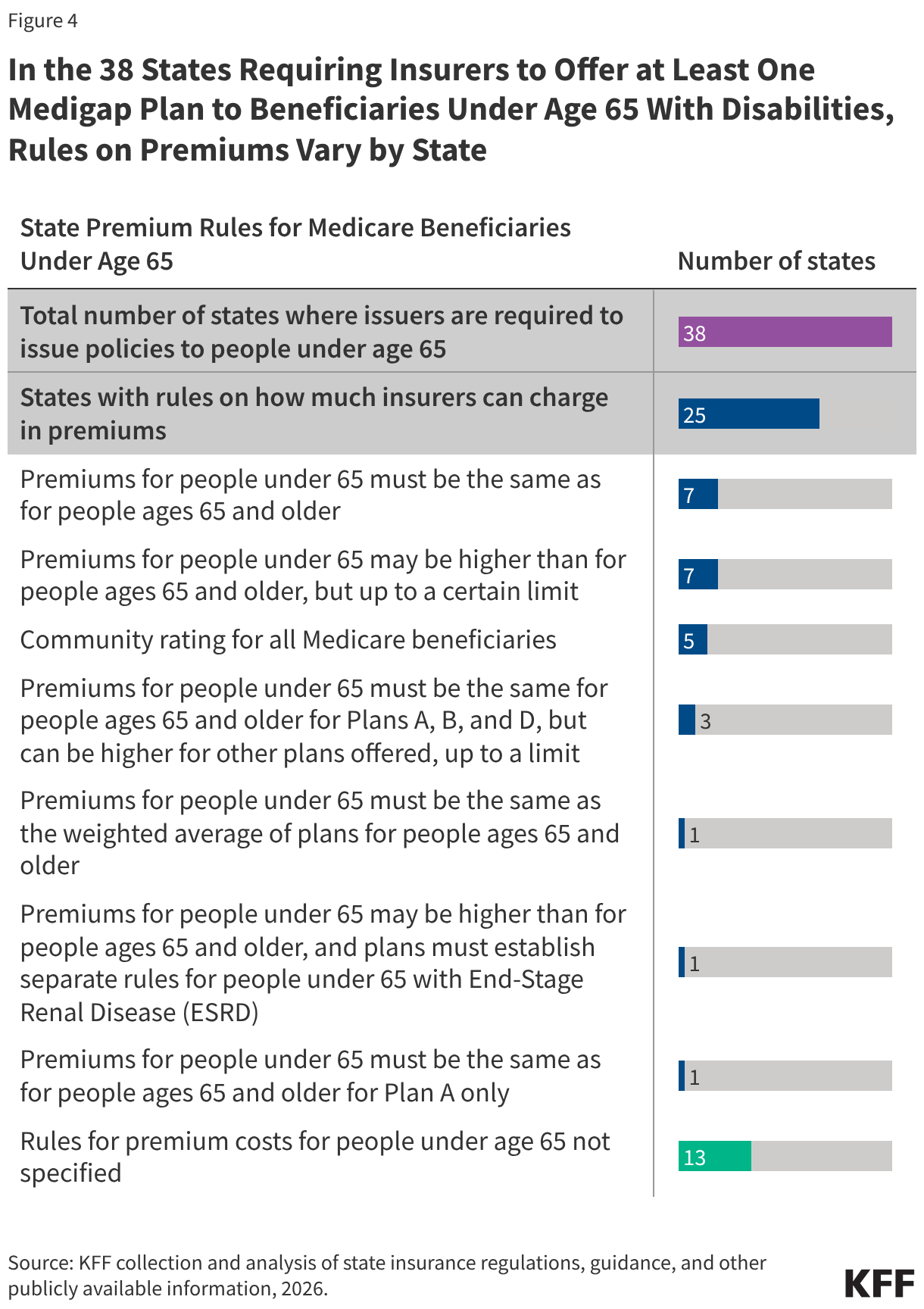
There are 38 states that require insurers to make at least one kind of Medigap policy guaranteed issue during an initial open enrollment period for beneficiaries under age 65, which is not a federal requirement. In these states, rules vary as to whether the same premiums are required for people under ages 65 and people ages 65 and older.
Among these 38 states, 25 states limit how much insurers can charge in premiums for beneficiaries under age 65. (Figure 4, Appendix Table 5). The remaining 13 states have no specified rules on premium costs.
Average Medigap Premiums Vary Among Current Policyholders by State and Policy Type
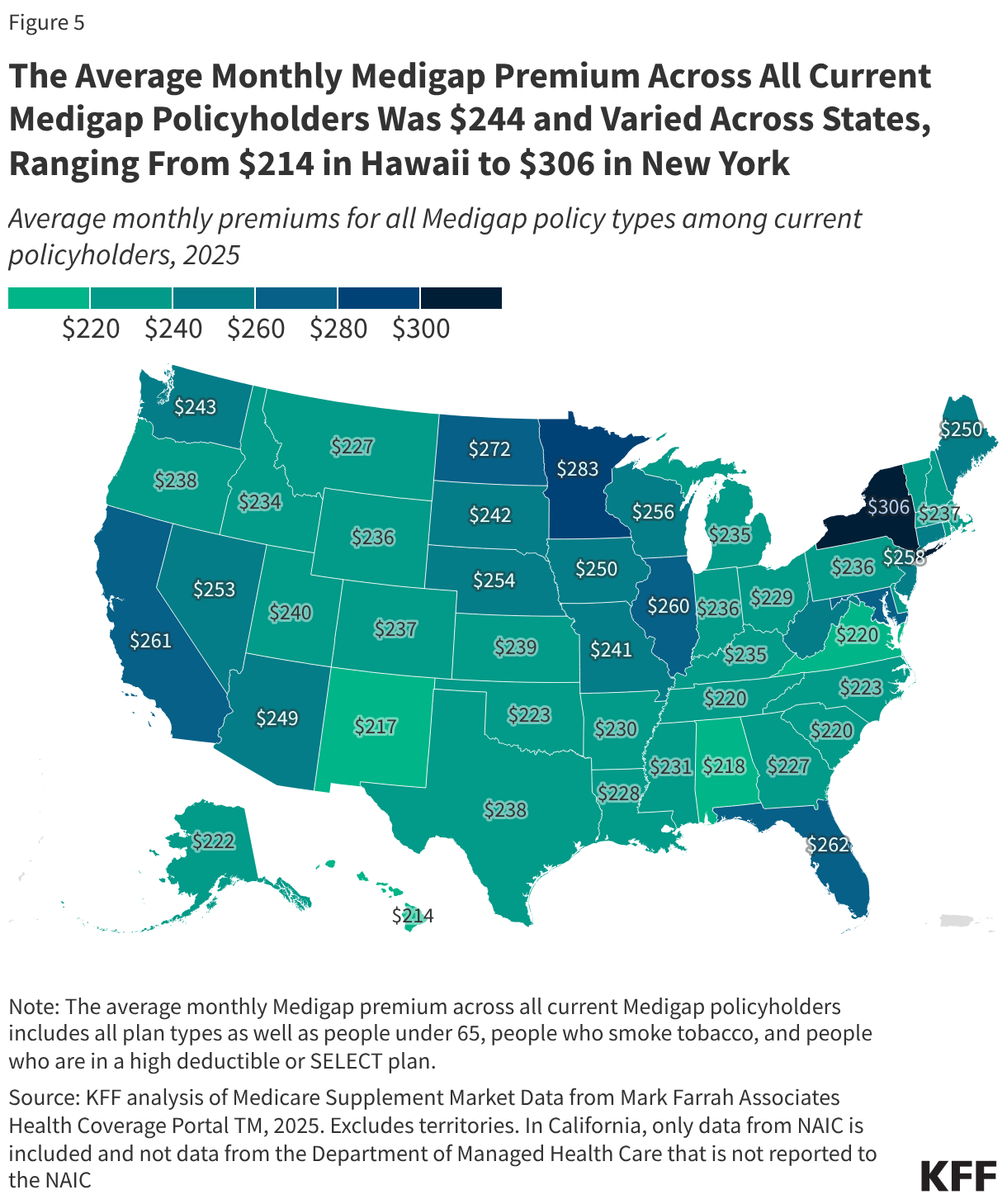
The average monthly Medigap premium across all current Medigap policyholders (including people under 65, people who smoke tobacco, and people who are in a high deductible or SELECT plan) was $244, ranging from $214 in Hawaii to $306 in New York in 2025 (Figure 5, Appendix Table 4).
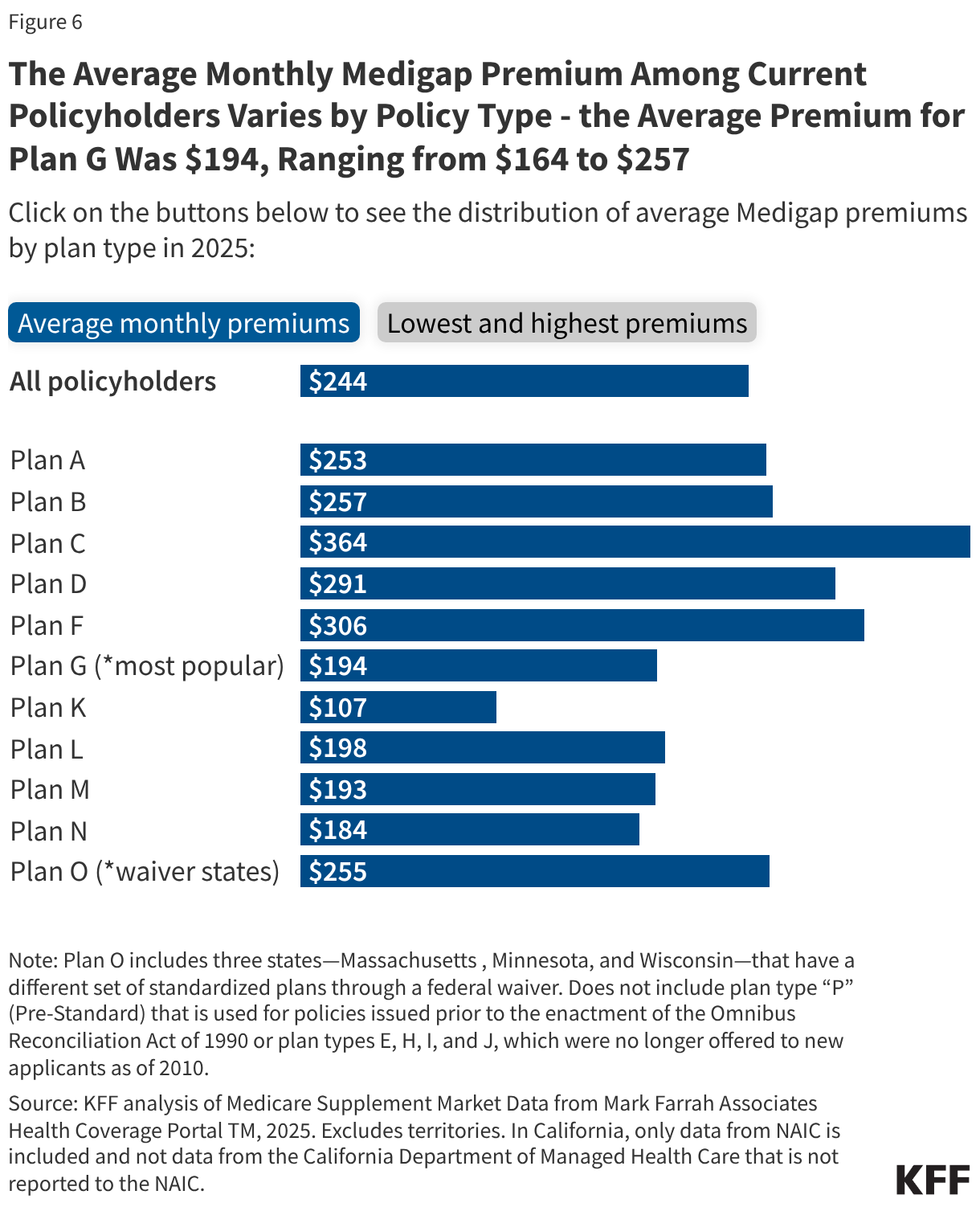
Average premiums also vary considerably depending on the policy type. For Plan G, the most popular and comprehensive plan available to newly eligible beneficiaries, the average monthly premium among current policyholders in 2025 was $194, and ranged from $164 in New Mexico to $257 in New York (Figure 6, Appendix Table 4). For Plan F, the plan with the second highest enrollment (but no longer available to Medicare beneficiaries who turned 65 after as of January 1, 2020), the average premium among current policyholders is $325, ranging from $243 in Vermont to $378 in Nebraska. The difference in premiums may be due in part to the fact that Plan F covers the Part B deductible, which Plan G does not cover, and that Plan G is enrolling new and younger beneficiaries, while Plan F covers an older group of beneficiaries since new enrollees are not eligible, creating different risk pools, though it may also be related to other factors, as described below. These data reflect what people currently pay, some of whom have had a Medigap plan for many years, rather than what a new enrollee might pay.
In the five states with the most expensive monthly premiums on average in 2025 for Plan G, four states (NY, CT, ME, WA) require community rating, while the fifth (FL) only allows issue-age rating. Further, the three states with highest premiums (NY, CT, and ME) have continuous or annual guaranteed issue protections. For Plan F, the state with the highest monthly premium is Nebraska, which is not community rated, followed closely by New York, which is community rated. The three states with the next highest premiums for Plan F (IN, IL, and ND) are not community rated and do not have guaranteed issue protections.
Overall, for average Medigap premiums across all current policyholders, there is no clear relationship between states with community rating rules or guaranteed issue protections and premium levels. For example, among guaranteed issue states, New York has the highest average monthly premium, but average monthly premiums in Connecticut and Maine are only slightly above the national average and the average in Massachusetts is slightly below the national average.
Differences in average premiums across states can be due to several factors, including Medigap rating requirements, guaranteed issue requirements, the number of Medicare beneficiaries, the characteristics of the Medicare population, Medicare Advantage penetration, urbanicity of the counties, and health care cost and usage patterns. Due to data limitations, differences in average Medigap premiums by gender, age, or smoking status cannot be evaluated.
Premium costs are one of the primary concerns for people with Medigap. KFF focus groups indicate that while most beneficiaries with Medigap are satisfied with their coverage and like many of its elements, including coverage of most or all of Medicare’s cost-sharing requirements, comprehensiveness of their coverage, control over their health care, and ability to see any provider they want (by virtue of being in traditional Medicare rather than Medicare Advantage), some participants noted their premiums were expensive or cost more than they would like.
Average Medigap Premiums Have Increased Over Time and Vary by Plan Type
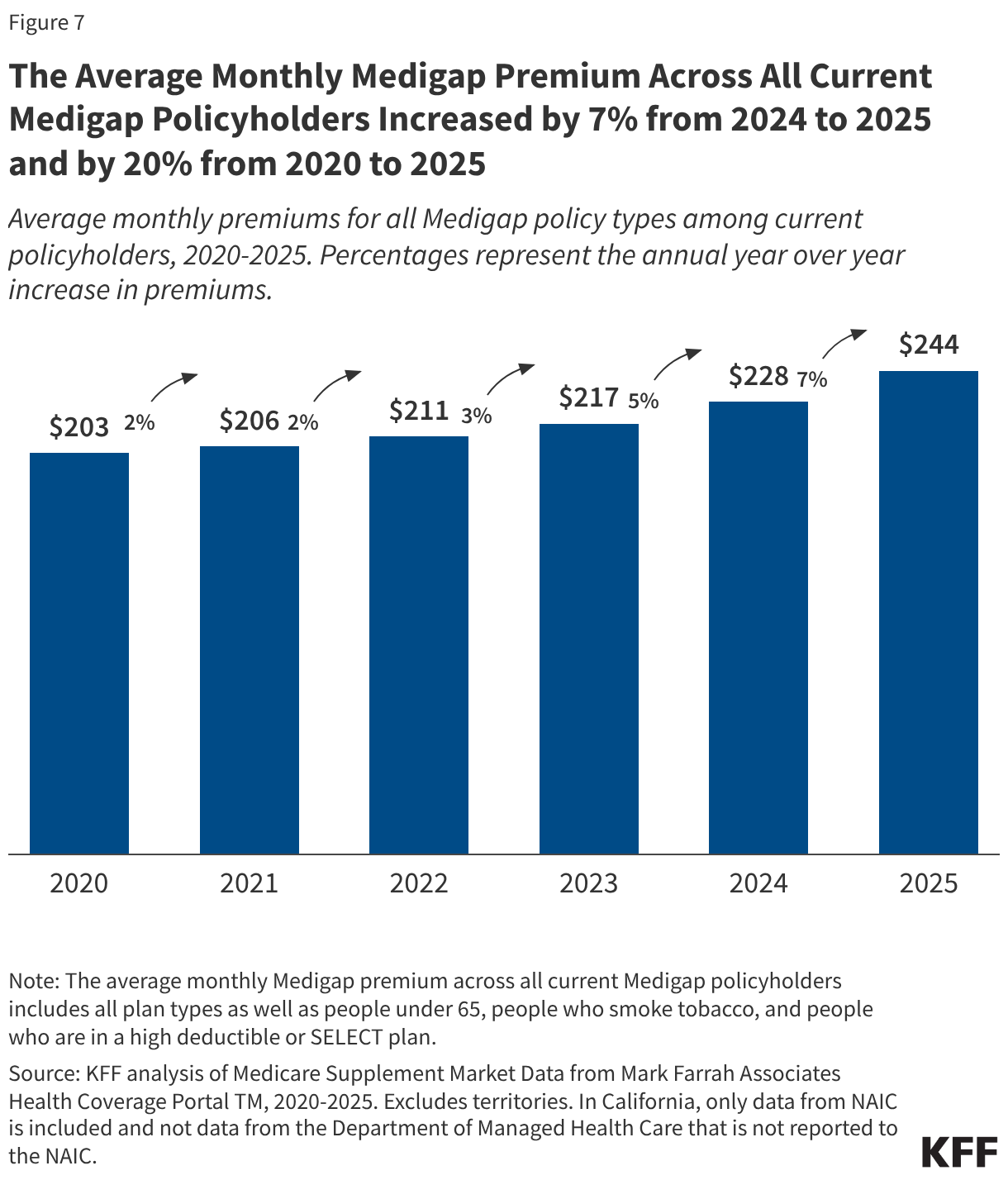
From 2024 to 2025, the average monthly Medigap premium increased by 7%, from $228 to $244, while the monthly Part B premium increased by 6% (from $174.70 to $185) – both outpacing the 2.7% increase in inflation. From 2020 to 2025, monthly Medigap premiums among current Medigap policyholders across all plan types increased 20% on average, increasing from $203 in 2020 to $244 in 2025 (Figure 7). Over the same time frame, the average monthly premium for Medicare Part B increased by 28% (from $144.60 to $185) and the consumer price index (CPI-U) increased by 24%.
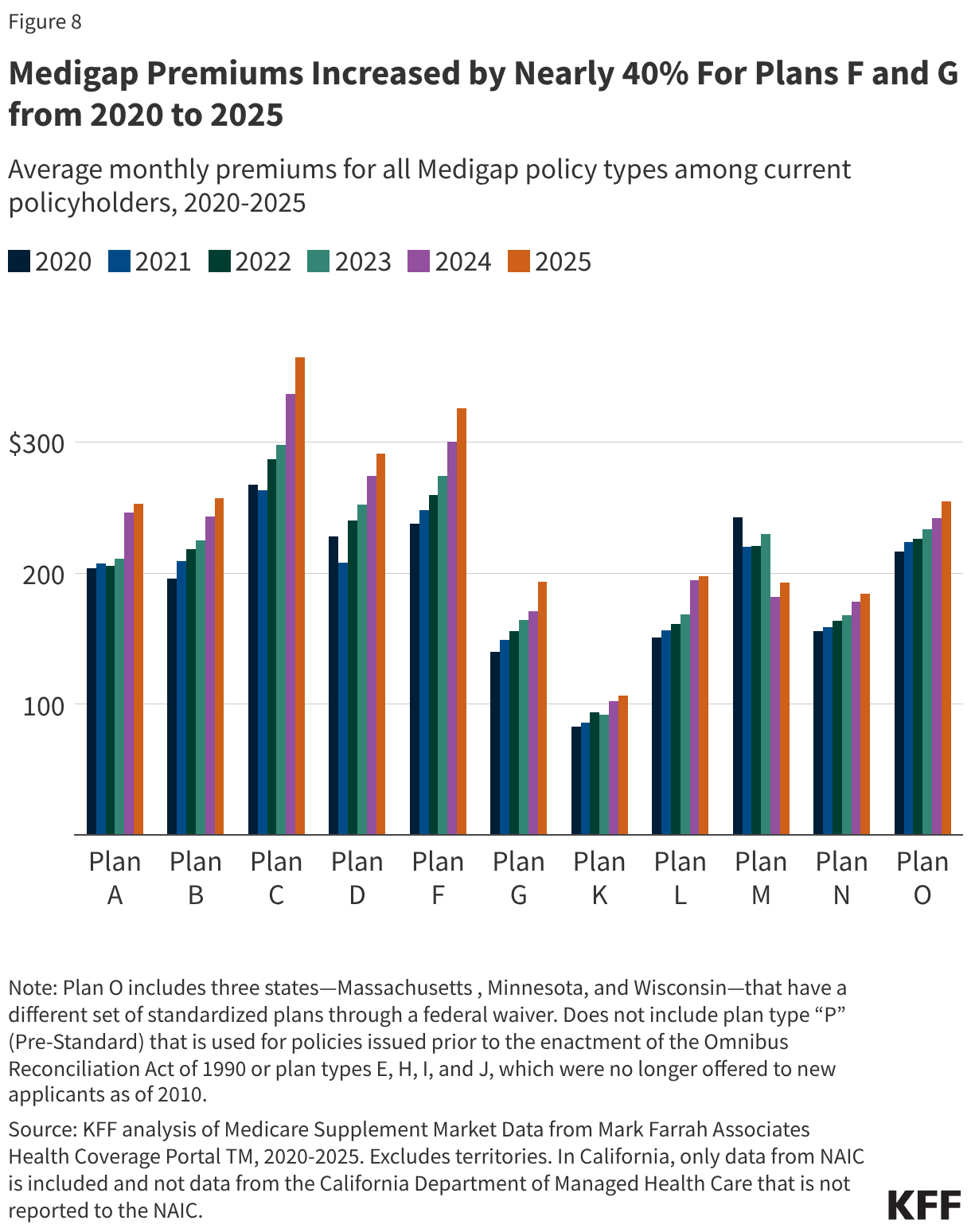
The increase in Medigap premiums also varies by plan type. For example, from 2024 to 2025, average Plan G premiums increased by 13% from $171 to $194 and average Plan F premiums increased by 8% from $300 to $325. From 2020 (when Plans D and G became first available) to 2025, overall average Medigap premiums increased by 20%, but for Plan G specifically, the average premium among current Medigap policyholders increased by 38% from $140 to $194 (Figure 8). Similarly, for Plan F, average premiums increased by 37% over that time frame from $238 to $325 (Figure 8). The only Medigap policy that experienced a decrease in the average monthly premium between 2020 and 2025 is Plan M, with less than 0.1% of Medigap enrollment, which decreased by 20% (from $242 to $193)—although consistent with all other Medigap policy types, the average premium for Plan M increased between 2024 and 2025.
Average Medigap premiums may have increased at different rates across plan types and time periods due to several factors, such as Medigap rating requirements, guaranteed issue requirements, the characteristics of the Medicare population, Medicare Advantage penetration in an area, and health care cost and usage patterns. In addition, because in many states it is difficult to switch Medigap plans (unless the state has a “birthday rule” or other opportunities to switch plans), some enrollees may face escalating Medigap premiums but are unable to purchase a cheaper policy. This may be particularly true for policyholders of Plans C or F, which are not open to newly eligible Medicare beneficiaries and cover the Part B deductible, which made these policies more expensive relative to Plans D and G, respectively.
“New or Innovative” Benefits in Medigap Policies
According to federal guidelines that took effect in the early 2000s, Medigap insurers may offer policies that cover “new or innovative” benefits that are cost-effective, in addition to the standardized Medigap benefits for cost-sharing assistance provided in a given policy. These new or innovative benefits can include vision, dental, and hearing benefits, access to a 24/7 nurse phone line, access to Silver Sneaker fitness benefits, and other wellness benefits – benefits that are not covered under traditional Medicare. Medigap policies that include these types of additional benefits often have slightly higher premiums than the standard version of the policy. There is no publicly available enrollment data on these policies specifically.
These benefits can vary across policy types and insurers. For example, some policies can include coverage of specific dental services, such as 100% coverage of dental diagnostic evaluations, preventive services, and diagnostic radiographs (x-rays), 75% of extractions and 50% of some restorative services (i.e. fillings) from in-network dentists, though they may not cover more comprehensive dental services. For other policies, rather than dental insurance, enrollees can receive discounts off nationally contracted rates for a range of dental services that are not covered by traditional Medicare, including cleanings, exams, fillings and crowns, from in-network dentists.
These additional benefits may be offered to help Medigap insurers compete for business with Medicare Advantage plans, nearly all of which offer coverage of dental, vision, and hearing services, as well as other extra benefits. KFF focus groups show that the availability of extra benefits in Medicare Advantage plans, such as dental and vision, is a major consideration when beneficiaries make their Medicare coverage choices. Moreover, KFF’s analysis of television ads from 2022 finds that messaging about extra benefits was mentioned in more than 90% of ads promoting Medicare Advantage. Dental coverage was the most advertised extra benefit (included in 84% of ads), followed by coverage of vision (63%) and hearing (56%) services.
Appendix

Methods
This analysis uses data from Health Coverage PortalTM, a market database maintained by Mark Farrah Associates, which includes information from the National Association of Insurance Commissioners (NAIC). We used the “Medicare Supplement Market Data” report from 2020-2025 for this analysis. For the analysis of Medigap enrollment and premiums, territories, including Puerto Rico, are excluded. For Medigap enrollment overall, data reported to the Department of Managed Health Care in California (554,225 beneficiaries in 2025) is included in overall California enrollment counts, but this data is not included for analysis of enrollment by policy type. For the analysis of average premiums among current Medigap policyholders, only data that is reported to the NAIC is included because data from the California Department of Managed Health Care does not include information about premiums or policy type. For that analysis, KFF excluded policies that have negative or zero dollars in premiums. Premiums for current policyholders include those who smoke tobacco and those with high deductible or SELECT policies.
For characteristics of Medicare beneficiaries with Medigap versus those with Medicare Advantage, KFF used the Centers for Medicare & Medicaid Services (CMS) Medicare Current Beneficiary Survey 2024 Survey File data. Data excludes beneficiaries with Part A only or Part B only for most of the year or Medicare as a Secondary Payer. Persons of Hispanic origin may be of any race but are categorized as Hispanic; other groups are non-Hispanic.